
ACL vs MCL vs Meniscus Tear | How to Tell the Difference
Table of Contents Show
Quick Summary
Knee pain can be confusing, especially when terms like ACL, MCL, and meniscus tear get mentioned. This article breaks down the differences in a clear, human way. You’ll learn how each injury happens, the key symptoms to watch for, and what recovery usually looks like. We also explain how supportive care, like massage therapy and acupuncture, can fit into the healing process.
Whether you’re dealing with knee pain now or want to understand how to protect your knees, this guide is here to help you feel informed, supported, and confident about your next step.
TL;DR – ACL vs MCL vs Meniscus Tear
ACL, MCL, and meniscus tears are three different knee injuries with different causes and symptoms
The way your knee hurts, swells, or feels unstable offers clues about which structure is injured
Not all knee tears require surgery, but early care matters
Massage therapy and acupuncture can support recovery and rehab when used at the right stage
Knowing how these injuries happen can help you reduce future risk
If your knee has started hurting after a hike, a workout, a fall, or even a normal day that suddenly didn’t feel so normal, it’s easy to spiral.
You might hear words like ACL, MCL, or meniscus and immediately wonder how serious this is or what comes next.
We see this often at our clinic. People come in worried, sometimes sore, sometimes scared, and usually confused. They’re not trying to self-diagnose. They just want to understand what their body is telling them and whether they’ve done something lasting.
Here’s the reassuring part. Knee injuries are common, and many of them are very manageable with the right care and timing.
Understanding the difference between an ACL tear, an MCL strain, or a meniscus issue can help you make calm, informed decisions instead of guessing or pushing through pain.
This guide is here to walk you through those differences in a clear and human way. No pressure. No fear-based language. Just practical information, explained the way we’d talk through it with a client in the room.
ACL vs MCL vs Meniscus Tear: What’s the Difference?
When someone comes in with knee pain, one of the first things we talk about is where the pain feels and what the knee is doing.
Is it feeling unstable? Is it catching or locking? Does it hurt more on one side than the other?
That’s because the knee isn’t just one structure. It’s a group of parts that all do slightly different jobs, and when one of them is irritated or injured, the knee tends to complain in its own way.
Here’s a simple way to think about it:
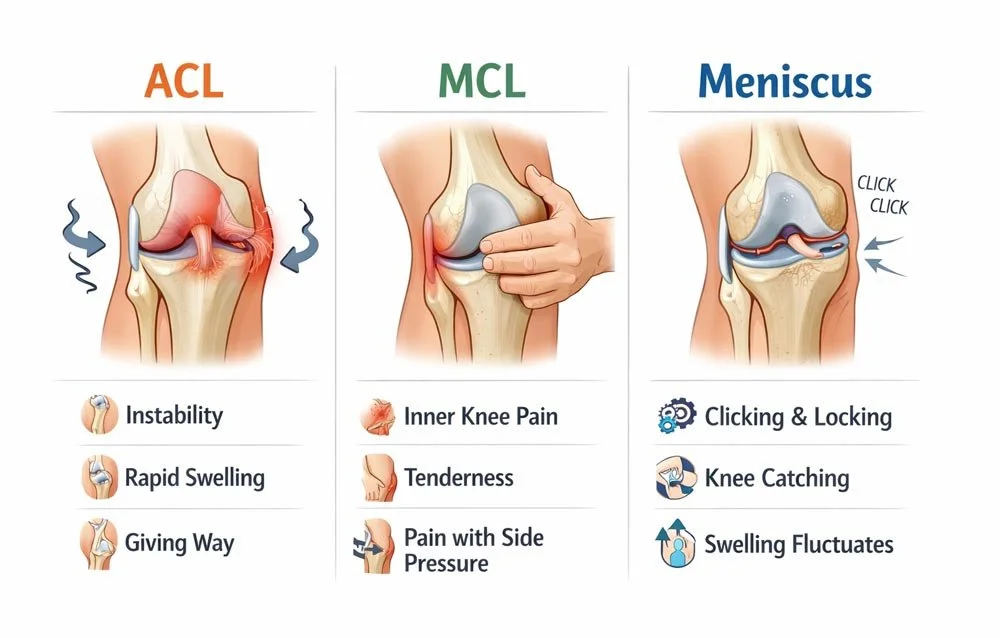
ACL injuries tend to affect how stable your knee feels, especially when you twist or change direction
MCL injuries usually show up as pain along the inner side of the knee, often after a knock or awkward movement
Meniscus injuries often feel mechanical, like clicking, catching, or the knee getting stuck during certain movements
None of these automatically means surgery. And none of them mean you’ve done something wrong. They just help narrow down what the knee might be reacting to, so care can be more targeted and effective.
From here, we’ll walk through each one in a bit more detail so you can see which description feels closest to what you’re experiencing.
How do I know if I tore my ACL, MCL, or meniscus?
Most people don’t know right away, and that’s completely normal. Knee injuries don’t always announce themselves clearly, and many symptoms overlap at first.
What usually helps is paying attention to how your knee feels and behaves, not just how much it hurts.
If your knee feels unstable or like it might give way, especially when turning or changing direction, that often points toward an ACL issue. People sometimes remember a specific moment where something felt off, even if the pain wasn’t severe.
If the pain is more focused along the inner side of the knee and feels tender or sore to touch, an MCL injury is more likely. Many people can still walk, but side-to-side movements or pressure tend to aggravate it.
If your knee clicks, catches, or feels stuck during certain movements, a meniscus issue may be to blame. Swelling with meniscus injuries often comes and goes rather than staying constant.
That said, knees don’t always follow clean rules. You don’t need to figure this out on your own. A professional assessment helps clarify what’s going on and prevents unnecessary guessing or overdoing it.
The most important thing is listening to your body and getting guidance early, especially if symptoms aren’t improving.
What Is an ACL Tear?
When we talk about an ACL tear, the first thing I usually tell someone is this: Hearing “ACL” doesn’t automatically mean worst-case scenario. It just tells us which part of the knee might be involved.
The ACL is a ligament that helps your knee feel stable when you turn, pivot, or change direction. You rely on it more than you realize, especially during things like sports, hiking downhill, or even catching yourself when you slip.
Most ACL injuries happen in a quick moment. A twist. A sudden stop. An awkward landing. People often remember the exact second it happened because it felt different than a normal strain.
-
ACL tears are commonly linked to:
Sudden twisting with the foot planted
Pivoting quickly during sports or exercise
Landing off balance from a jump
Slips where the knee rotates unexpectedly
You don’t have to be a competitive athlete for this to happen. We see it in weekend warriors, recreational skiers, gym goers, and people who simply moved the wrong way at the wrong time.
-
People often describe:
A popping sound or sensation at the moment of injury
Swelling that shows up fairly quickly
A feeling that the knee doesn’t fully trust itself
Difficulty continuing the activity that caused it
One thing we hear a lot is, “It didn’t hurt as much as I expected, but it felt unstable.” That feeling matters and it’s worth paying attention to.
-
Treatment depends on the person, not just the ligament.
Some people do very well with a structured rehab approach that focuses on strength, control, and confidence in the knee again. Others, especially those returning to high demand sports, may be guided toward surgical options after proper assessment.
Supportive care like massage therapy can play a helpful role during recovery by easing tension in the muscles that tighten up to protect the knee and by supporting movement as rehab progresses.
The most important step is getting clear guidance early, so you’re not guessing or pushing through something that needs attention.
What Is an MCL Tear?
An MCL injury usually shows up differently than an ACL injury. Instead of feeling unstable or unpredictable, the knee tends to feel sore, tender, and protective, especially along the inner side.
The MCL runs along the inside of your knee and helps keep it from collapsing inward. When it’s irritated or strained, the knee often lets you know right away, but in a more localized, aching way rather than a sudden loss of control.
A lot of people are surprised to learn they can still walk with an MCL tear. That doesn’t mean it should be ignored, but it does explain why these injuries sometimes get brushed off at first.
-
MCL injuries usually occur when the knee is pushed inward. We commonly see this from:
A direct hit to the outside of the knee
Ski falls where the knee twists inward
Slips or stumbles where the leg collapses toward the body
In Vancouver, skiing and winter sports are frequent culprits, but even a misstep on wet pavement can do it.
-
People with MCL injuries often notice:
Pain along the inner side of the knee
Tenderness when touching that area
Swelling that stays closer to the inside
Discomfort when bending or fully straightening the knee
The knee may feel stiff or guarded rather than unstable.
-
The encouraging news is that many MCL injuries respond well to conservative care.
Treatment often focuses on:
Protecting the knee early while it settles
Gradual movement and strengthening
Restoring confidence in side to side motion
Massage therapy and myofascial work can be useful here, especially for easing the tension that builds up in the inner thigh and surrounding muscles as the body tries to protect the joint.
As with any knee injury, early guidance helps prevent compensations that can slow recovery.
What Is a Meniscus Tear?
Meniscus injuries can be tricky. They don’t always announce themselves loudly, and they don’t always happen during a big moment. Sometimes the knee just starts behaving differently, and that can be frustrating.
The meniscus is a piece of cartilage that sits inside the knee joint and acts like a cushion. It helps absorb shock and keeps movement smooth. When it’s irritated or torn, the knee often feels less fluid, almost like it’s catching on something it shouldn’t.
Unlike ligament injuries, meniscus issues don’t always come with immediate swelling or instability. Instead, people usually notice changes in how the knee moves.
-
Meniscus tears can happen in a few different ways:
Twisting while your foot is planted
Squatting or lifting with rotation
Gradual wear over time, especially as tissues lose flexibility
We see this in active people, but also in those who sit a lot and then move suddenly. It’s not always about impact. Sometimes it’s about timing and load.
-
People often describe:
Clicking or catching inside the knee
A feeling that the knee gets stuck during certain movements
Swelling that comes and goes rather than staying constant
Pain with stairs, squatting, or getting up from low positions
One phrase we hear a lot is, “It feels like my knee isn’t moving smoothly anymore.” That’s often an important clue.
-
Treatment depends on the type of tear and how the knee is responding.
Many meniscus tears do well with:
Activity modification
Rehab focused care
Gradual return to movement rather than rest alone
Surgery is usually considered only when the knee keeps locking or symptoms don’t improve with conservative care.
Supportive treatments like acupuncture and manual therapy can help manage pain, swelling, and movement patterns while the knee settles and adapts.
The key is not forcing movements that feel wrong, even if they don’t feel painful yet.
ACL vs MCL vs Meniscus: Making Sense of the Differences
After hearing about all three injuries, it’s normal to feel a bit unsure. A lot of knee symptoms overlap, especially early on. That’s why we don’t rely on just one sign. We look at patterns.
What your knee feels like day to day often gives us helpful clues.
Here’s a simple way to compare them, not to diagnose yourself, but to help you describe what’s going on more clearly.
ACL injuries often stand out because of how the knee behaves. People usually notice a feeling of instability, especially when turning or changing direction. Swelling tends to show up fairly quickly, and there’s often a clear moment where something didn’t feel right.
MCL injuries are usually more localized. The discomfort sits along the inner side of the knee and tends to feel sore or tender rather than unpredictable. Many people can still walk, but side-to-side movement or pressure can feel uncomfortable.
Meniscus injuries often feel mechanical. The knee may click, catch, or feel like it momentarily gets stuck during certain movements. Swelling might come and go, and pain often occurs when going up and down stairs, squatting, or getting up from low positions.
If one of these descriptions feels closer to your experience, that’s useful information to bring into a conversation with a professional. And if none of them fit perfectly, that’s okay too. Knees don’t always read the textbook.
The goal here isn’t to label yourself. It’s to help you understand your knee well enough to take the next step with confidence, rather than guessing.
A quick way to tell them apart
ACL: instability, rapid swelling, giving way
MCL: inner knee pain, tenderness, pain with side pressure
Meniscus: clicking, locking, swelling that fluctuates
This isn’t a diagnosis, but it helps guide next steps.
How Massage Therapy and Acupuncture Support Knee Injury Recovery
Once we understand what might be happening in the knee, the next question is usually, “What can I do now?”
Massage therapy and acupuncture don’t replace imaging or medical assessment, but they can play a meaningful role in recovery when used at the right time and for the right reasons.
When the knee is injured, the body often responds by tightening the surrounding tissues. Muscles in the thigh, hip, and even the lower back can start working overtime to protect the area. That tension can limit movement, slow recovery, and sometimes create new discomfort elsewhere.
Massage therapy helps by:
Easing muscle tension that builds up around the knee
Improving circulation to support healing
Supporting better movement patterns as rehab progresses
Assisting the body in feeling safer moving again
Acupuncture can be especially helpful when pain or swelling feels stubborn. It’s often used to:
Calm irritation in the joint
Support circulation and tissue response
Help regulate the nervous system during recovery
We often see knee pain improve once the surrounding areas stop compensating and the body isn’t constantly guarding. Recovery tends to feel smoother, not rushed.
The most important part is timing and coordination. These treatments work best when they’re part of a bigger plan that respects where the knee is at right now.
FAQ
Can you walk with an ACL tear?
Sometimes, yes. Many people can walk after an ACL tear, especially once the initial swelling settles. What often stands out more than pain is a feeling that the knee doesn’t fully trust itself. That instability is important to pay attention to, even if walking feels possible.
Do meniscus tears heal on their own?
Some meniscus tears can settle with the right rehab, activity changes, and time. Others may continue to cause catching or locking. It really depends on the type of tear and how the knee responds. If movement keeps feeling off, it’s worth getting guidance rather than pushing through it.
Is an MCL tear less serious than an ACL tear?
Not necessarily. MCL injuries often heal well with conservative care, but they can still be painful and limiting. The difference is usually in the recovery approach, not the importance. Both deserve proper attention.
Can massage therapy help knee injuries?
Yes, when used at the right stage. Massage therapy can help reduce muscle tension, improve movement, and support recovery around the knee. It works best as part of a broader plan rather than a standalone fix.
How long does recovery usually take?
Recovery timelines vary widely. Some people feel improvement in weeks, while others need months of gradual rehab. Factors like the type of injury, activity level, and consistency with care all play a role. The goal is steady progress, not rushing.

Knee pain can limit movement, sleep, and everyday comfort. This article explains common knee injuries and arthritis, plus how massage therapy and acupuncture can reduce pain, improve mobility, and support long-term recovery without relying only on medication.
Final Thoughts
Knee injuries can feel unsettling, especially when the names start piling up, and everything sounds serious. ACL, MCL, meniscus. They’re just labels for different ways the knee might be asking for attention.
What matters most is this. You’re not expected to figure it all out on your own. Most knee injuries improve when they’re recognized early and properly supported. The body is adaptable, and with the right guidance, it often recovers better than people expect.
If your knee feels unstable, sore, or just not quite right, that’s worth listening to. Not with fear, but with curiosity. Paying attention now can prevent months of frustration later.
At West End Wellness, we see people at all stages of knee pain. Some are fresh off an injury. Others have been quietly dealing with discomfort for months. Wherever you’re at, support should feel calm, clear, and tailored to you.
If you’re looking for help understanding what your knee needs next, we’re here to walk that path with you. One step at a time.
If you have any further doubts or questions regarding this subject or another treatment, contact one of our experienced Acupuncturists or Registered Massage Therapists here at West End Wellness Clinic. You can either give us a call or make an appointment.
Disclaimer: Please remember this article is for informational purposes only and should not replace professional medical advice. Please consult a healthcare provider or someone with the correct qualifications before starting any new exercise or treatment program.