
Meet the Pregnenolone Steal: Stress's Quiet Hormone Heist

Table of Contents Show
Quick Summary
Chronic stress does more than wear you out. It quietly borrows from your hormone supply. It redirects raw materials away from estrogen, progesterone, and testosterone, keeping your cortisol running. The result is a body that feels wired, foggy, tired in the morning, and restless at night. This article walks through exactly how that happens, why your symptoms are not random, and what you can do to stop the cycle.
Whether you are dealing with low energy, mood swings, or disrupted sleep, understanding the cortisol connection is the first step to feeling like yourself again.
TL;DR – Acupuncture and Digestive Health
Chronic stress forces your body to overproduce cortisol at the expense of other hormones
Pregnenolone steal redirects raw hormone material, lowering estrogen, progesterone, and testosterone
A stuck HPA axis explains wired-but-tired, broken sleep, and a mood that won't budge
Massage and acupuncture directly activate the parasympathetic system and lower cortisol
Rebalancing takes weeks, not days, but consistent inputs produce real, measurable change
You are doing everything right. You are sleeping enough, more or less. You are keeping up with work, your family, and your life.
But somewhere in the last year or two, your body started sending signals that do not quite add up. The PMS got worse. The sleep got lighter. The irritability arrives faster than it used to, and the energy that used to carry you through a full Vancouver week now runs dry by Wednesday afternoon.
A lot of women in their 30s and 40s hear "it's just stress" and leave it at that.
But stress does not just make you tense.
When it runs long enough, it physically borrows from your hormone supply, redirecting the raw material your body uses to make estrogen, progesterone, and testosterone toward producing more cortisol instead.
Researchers call this the pregnenolone steal, and it is one of the most underrecognized reasons women feel hormonally off even when standard tests come back normal.
Chronic stress can keep your cortisol levels elevated or dysregulated, which in turn disrupts other hormone systems through the HPA axis, affecting functions like metabolism, reproduction, and thyroid balance
Here is what is actually happening, and what you can do about it.
The Hormone Your Body Prioritizes Above All Others
Cortisol is your primary stress hormone. The adrenal glands release it in response to anything the brain flags as a threat: a deadline, an argument, a skipped meal, a restless night. In short bursts, cortisol is useful. It sharpens focus, raises blood sugar for quick energy, and suppresses inflammation. The problem starts when the trigger never goes away.
Modern life gives your adrenal glands very little downtime. Back-to-back meetings, financial pressure, poor sleep, and scrolling through the news all count as stressors to your nervous system. The body does not distinguish between a bear and an overflowing inbox. It just keeps producing cortisol.
What most people do not realize is that cortisol does not get made from nothing. It is synthesized from pregnenolone, a master hormone that also feeds the production of estrogen, progesterone, testosterone, and DHEA. When cortisol demand stays high, pregnenolone gets redirected.
Other hormones get less of what they need. Researchers refer to this as pregnenolone steal. It explains why prolonged stress can unravel hormonal balance across the board, not just leave you feeling tense.
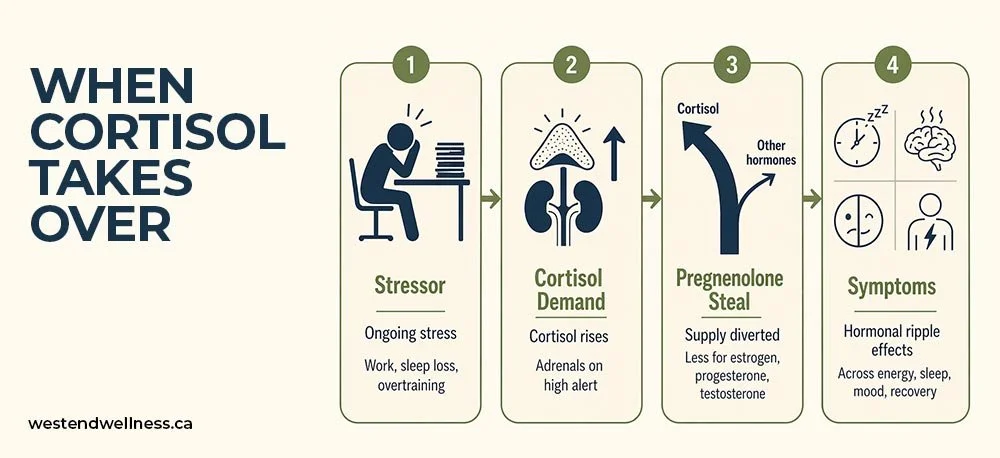
What Happens When Cortisol Crowds Out the Others
The downstream effects of cortisol dominance are not subtle once you know what to look for. They show up as a cluster of symptoms that feel unrelated but actually share the same root. A disrupted stress response does not just affect your mood. It touches sleep, digestion, libido, and immune function.
Here is what tends to shift when cortisol stays elevated for weeks or months:
Progesterone drops. Progesterone and cortisol compete for the same precursor. Low progesterone means lighter, shorter cycles, worse PMS, disrupted sleep, and higher anxiety. Many people chasing a "progesterone deficiency" are really dealing with a cortisol surplus.
Estrogen loses its counterbalance. When progesterone falls, estrogen can feel dominant even without rising. This relative imbalance drives bloating, breast tenderness, and mood swings.
Testosterone declines. Chronic cortisol suppresses luteinizing hormone (LH), which signals the body to produce testosterone. Low testosterone shows up as reduced motivation, brain fog, and a drop in physical recovery.
Thyroid function slows. High cortisol levels inhibit the conversion of T4 to the active thyroid hormone T3. The result mimics hypothyroidism: fatigue, weight resistance, cold sensitivity, even with a normal TSH reading.
Blood sugar becomes erratic. Cortisol raises glucose for quick energy. Over time, this trains the body toward insulin resistance, energy crashes, and carbohydrate cravings that feel impossible to ignore.
Research published in Annual Review of Psychology confirms that chronic psychological stress alters immune, endocrine, and autonomic function through overlapping pathways. The hormonal disruption stress causes is not linear. It cascades.
The HPA Axis: Why Your Stress System Gets Stuck
Your hypothalamic-pituitary-adrenal (HPA) axis is the command chain for your stress response. The hypothalamus detects a threat and signals the pituitary gland, which signals the adrenal glands to release cortisol. Normally, rising cortisol feeds back to the hypothalamus, signalling "enough" and slowing production.
Under sustained stress, that feedback loop breaks down. The hypothalamus stops responding to cortisol's off-signal. The system stays stuck in drive. Sleep quality drops because cortisol should be lowest at night, but it isn't. Morning energy tanks because the cortisol awakening response, which should spike 30 minutes after waking, has gone flat from exhaustion.
This is what people mean when they say they feel "wired but tired." It is not a personality type. It is a dysregulated HPA axis.
The body's autonomic nervous system is caught in the same loop. The sympathetic branch (fight-or-flight) remains activated. The parasympathetic branch (rest and digest) can’t get enough airtime. Digestion slows, muscle tension builds, and the body loses its ability to fully recover overnight.
If you have been reading about the vagus nerve and its role in calming the nervous system, this is exactly the circuit it sits in.
Signs Your Hormones Are Caught in a Cortisol Loop
The tricky part is that cortisol-driven hormone disruption does not announce itself clearly. The symptoms land in different systems and often get treated in isolation: a sleep aid here, an antidepressant there, a thyroid recheck that comes back normal. These are a few of the patterns worth paying attention to.
Waking between 2 am and 4 am with a racing mind
Energy that crashes by mid-afternoon regardless of sleep
PMS that has worsened over the last year or two
Low motivation or mood that does not respond to the usual things
Brain fog or slow thinking, especially under pressure
Increased belly fat without a change in diet
Irritability that feels disproportionate to what triggered it
Recovery from exercise is taking longer than it used to
None of these in isolation means cortisol is the culprit. But a cluster of them, especially when accompanied by ongoing stress, is a strong signal that the nervous system is running behind, and the hormonal picture is worth a closer look.

Discover how your diet, lifestyle, and daily habits can impact your hormonal health. Learn to decode your body's signals and take charge of your well-being with practical, easy-to-implement strategies for hormone harmony.
What Actually Helps (Beyond "Stress Less")
Telling someone with a dysregulated stress response to just relax is about as useful as telling someone with a broken leg to walk it off. What actually helps is working with your physiology.
Give the nervous system real signals that it is safe to downshift.
-
Massage therapy has a documented effect on the HPA axis. Therapeutic touch activates the parasympathetic nervous system, lowers heart rate, and reduces circulating cortisol. A session at West End Wellness with one of our RMTs is not just about tight muscles.
It is a direct input into the stress response system, one your body reads as safety. The science behind massage therapy goes deeper than most people realize, including its effects on cortisol and serotonin. -
Item descriptionAcupuncture works partly by stimulating the vagus nerve and reducing HPA axis hyperactivity. A review published in Sleep Medicine found that acupuncture treatment was associated with improvements in sleep quality among individuals with insomnia. That is one of the clearest downstream markers of cortisol dysregulation.
At West End Wellness, our acupuncture team works with patients dealing with stress-related anxiety and the hormonal disruption that often travels with it.
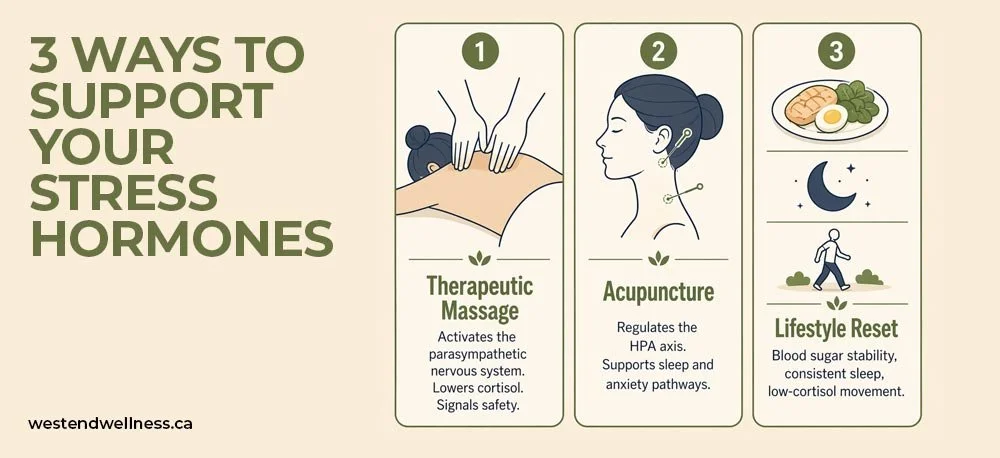
Lifestyle Inputs That Actually Move the Needle
Three things have the strongest evidence base for HPA regulation outside clinical treatment:
Blood sugar stability. Skipping meals spikes cortisol. Eating protein with each meal and not going more than four to five hours without food significantly reduces adrenal demand.
Sleep architecture. Cortisol and melatonin work on opposite rhythms. Keeping a consistent sleep and wake time (even on weekends) is one of the fastest ways to start resetting the cortisol curve.
Movement without overdoing it. High-intensity training acutely raises cortisol, which is fine when you recover. But if your baseline is already elevated, adding intense exercise without adequate recovery extends the problem. Walking, swimming, and yoga are lower-cortisol options during a reset period.

FAQ
Can stress really cause a hormone imbalance?
Yes. Sustained stress keeps cortisol elevated, which redirects the raw material your body uses to make estrogen, progesterone, testosterone, and thyroid hormones. This is sometimes called pregnenolone steal. The result is a shift in your hormone balance that has nothing to do with your reproductive organs. It starts in your adrenal glands.
What does cortisol dominance feel like day to day?
Common patterns include waking in the night, slow morning energy, afternoon crashes, increased belly fat, worsened PMS, brain fog, and mood that feels harder to regulate than usual. None of these alone confirms elevated cortisol, but a cluster of them, alongside ongoing stress, is worth addressing.
How does massage help with hormones?
Therapeutic massage activates the parasympathetic nervous system, which is the opposite of the fight-or-flight response. This lowers circulating cortisol and supports better serotonin and oxytocin levels. Regular sessions can help shift the body out of chronic stress mode and give the hormonal system room to rebalance.
How does acupuncture affect cortisol?
Acupuncture stimulates the vagus nerve and helps regulate HPA axis activity, the command chain for your stress hormone response. Clinical studies show it can lower cortisol, improve sleep quality, and reduce anxiety. It works best as a consistent treatment rather than a one-off session.
How long does it take for stress hormones to rebalance?
It depends on how long the pattern has been in place and what you are doing to address it. Most people notice improvements in sleep and energy within three to six weeks of consistent lifestyle changes and treatment. Full hormonal rebalancing can take two to four months. There are no shortcuts, but the changes are real.
Conclusion
If you have been feeling off for a while, tired but unable to sleep and stressed without a clear reason, it is worth looking at cortisol before assuming the problem lies elsewhere. Your body is not failing you. It is doing exactly what a stress response system does when it never gets the signal to stand down.
The good news is that the signal can be sent. Consistently, intentionally, and with the right support.
Our team at West End Wellness works with clients dealing with stress-related tension, sleep disruption, and the physical toll of long-term burnout. Whether that means massage therapy, acupuncture, or simply knowing where to start, we are here to help you find the thread and pull it.
Book an appointment at our Davie Street clinic, or reach out with questions. You do not have to figure this one out alone.
If you have any further doubts or questions regarding this subject or another treatment, contact one of our experienced Acupuncturists or Registered Massage Therapists here at West End Wellness Clinic. You can either give us a call or make an appointment.
Disclaimer: Please remember this article is for informational purposes only and should not replace professional medical advice. Please consult a healthcare provider or someone with the correct qualifications before starting any new exercise or treatment program.