
RMT Massage for Sore Muscles: Does It Actually Work?
Table of Contents Show
Quick Summary
That ache that arrives the morning after a long run along the Seawall or a week spent hunching over a laptop has a name and a mechanism. Delayed onset muscle soreness (DOMS) is your body repairing microscopic muscle damage, and while it's a normal part of getting stronger, it doesn't have to sideline you for days.
This article explains why muscles get sore, what RMT massage does at a tissue level, and which techniques work best depending on what you're dealing with. Whether you're recovering between training sessions or your shoulders haven't felt right in months, the right massage at the right time can meaningfully shorten how long that soreness sticks around.
TL;DR – Is RMT Massage Ideal for Sore Muscles?
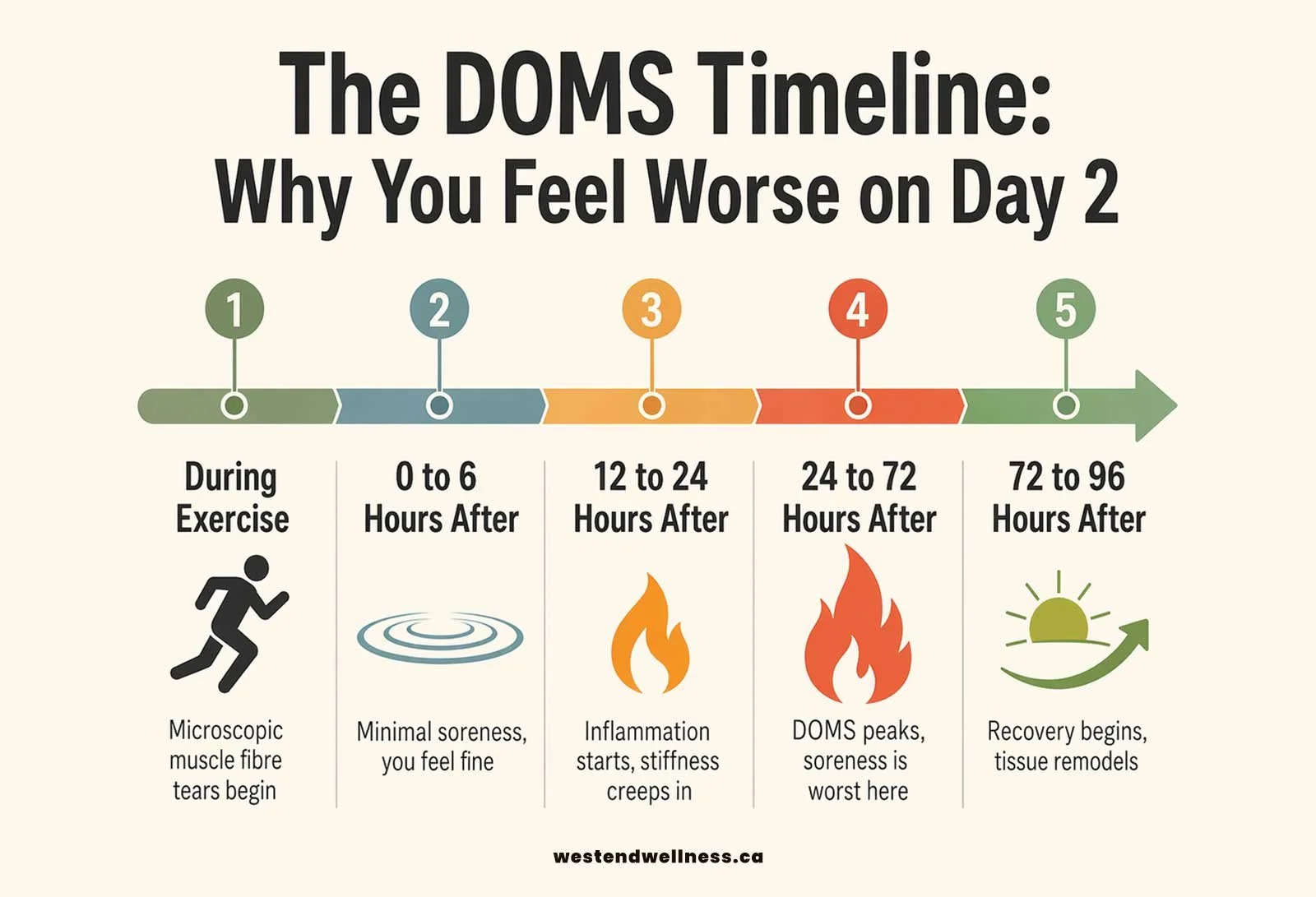
Delayed onset muscle soreness (DOMS) peaks 24 to 72 hours after activity, not right after
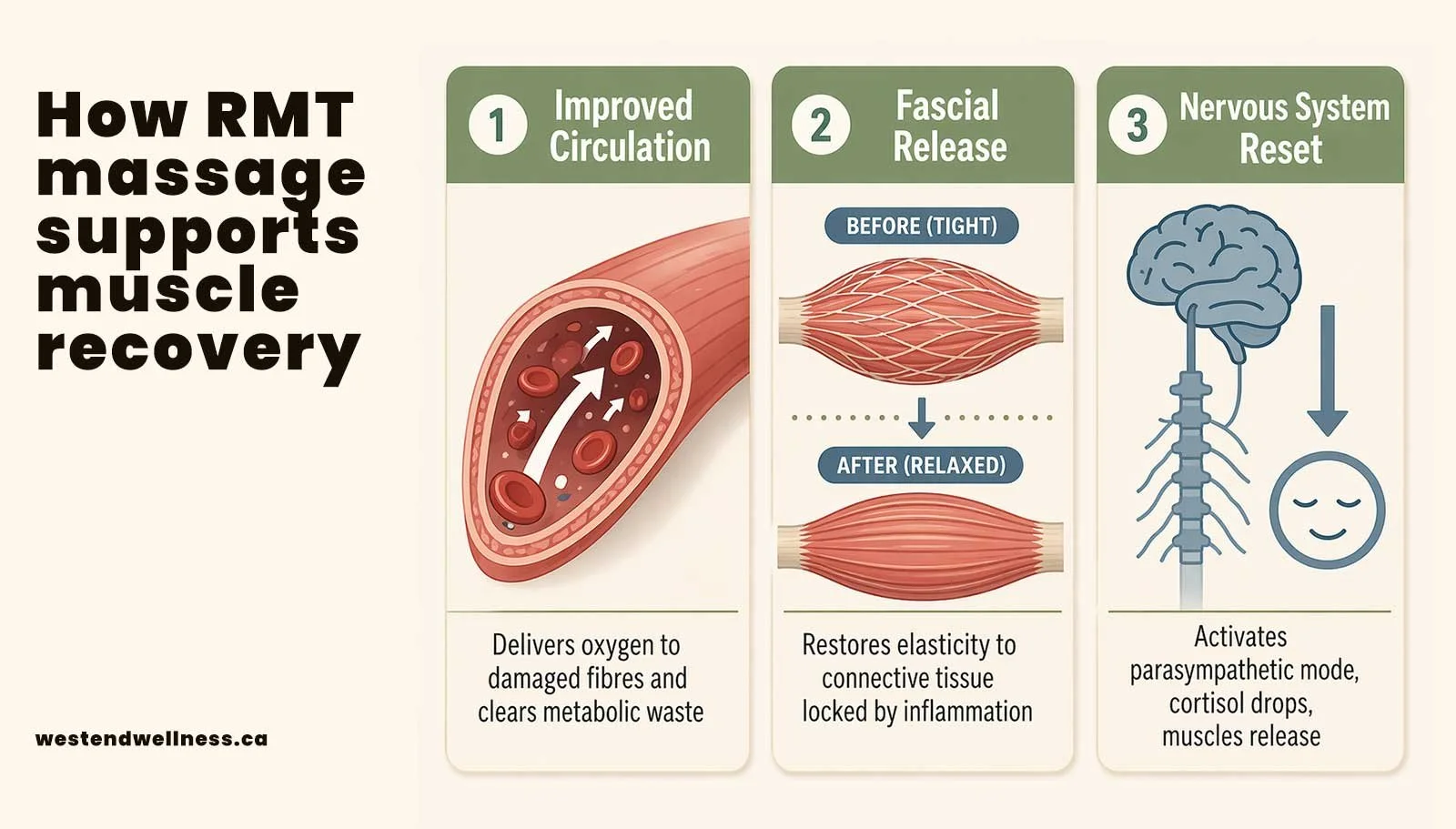
RMT massage speeds recovery by improving circulation, releasing fascial tension, and lowering cortisol
Deep tissue, trigger point, and myofascial release are the most effective techniques for sore muscles
Timing matters: booking 24 to 48 hours after the activity works better than going in while acutely inflamed
Massage works for both post-workout soreness and the chronic tension that builds from sitting at a desk all week
You pushed hard on Monday. Tuesday felt fine. Then Wednesday arrived, and your legs were concrete.
That delayed wave of soreness throws a lot of people off. It's also one of the most common questions our RMTs hear. "I didn't feel sore right away, so why am I wrecked two days later?"
The answer has everything to do with how muscles actually heal. And once you understand that, the case for massage at the right moment becomes clear.
Most people either push through, wait it out, or reach for ibuprofen. All of those can help to some degree.
But muscle soreness, especially delayed-onset muscle soreness, tends to peak 24 to 72 hours after activity due to microtears and inflammation.
Registered massage therapy works more directly on these tissue-level changes, helping reduce stiffness, improve circulation, and ease that locked-up feeling.
This article walks through what's happening in your muscles, how RMT addresses it, and what to expect from a session at our downtown Vancouver clinic.
Why You Feel Worse on Day Two Than Day One
Most people assume soreness is about lactic acid building up during exercise. That's a common myth. Lactic acid actually clears from your muscles within an hour or two after you stop activity.
What causes that deep, achy soreness 24 to 72 hours later is something different: microscopic tears in the muscle fibres themselves.
This is called delayed onset muscle soreness, or DOMS. It's the body's natural repair response to unfamiliar or high-intensity effort.
When muscles are stressed beyond their usual limits, small amounts of damage occur in the fibres and the surrounding connective tissue.
The body floods the area with inflammatory signals to start the repair process, and that's what you feel as pain and stiffness.
DOMS is not a sign that something is wrong. It's a sign that adaptation is happening.
But the inflammation and fluid that accumulate can compress local nerves, restrict circulation, and leave muscles feeling tight and non-responsive for days.
That's where intervention helps.
Rather than waiting for the inflammation to resolve on its own, targeted massage can support the process and shorten the recovery window considerably.
What RMT Massage Actually Does at the Tissue Level
The benefits of massage for sore muscles aren't just about relaxation.
There are specific mechanical and physiological effects that make a real difference in how quickly tissue heals.
According to research published in the Journal of Strength and Conditioning Research, massage applied 48 hours after exercise significantly reduced muscle soreness and improved performance recovery compared to controls.
-
Massage increases blood flow to the area being worked. More blood means more oxygen and nutrients arriving at damaged muscle fibres, and faster removal of the metabolic waste products that build up during repair.
This is one of the main reasons you feel noticeably less stiff after a session circulation was likely compromised before you came in. -
Fascia is the connective tissue that wraps around every muscle in your body. When muscles are inflamed or overworked, fascia can tighten and adhere which is part of why sore muscles feel so locked up rather than just painful.
Myofascial release techniques work specifically on this tissue, restoring elasticity and allowing muscles to move freely again. You can read more about this in our article on massage for inflammation. -
Massage activates the parasympathetic nervous system, your body's rest and repair mode. Cortisol drops. Endorphins rise. Muscles that were braced against pain start to let go.
For people carrying both physical soreness and daily stress, this nervous system shift is often the most noticeable part of the session.
Normal Soreness vs Something More Serious
You’re sore. That part’s obvious.
What’s harder to figure out is whether it’s the kind of soreness that just needs time… or something your body is asking you to pay attention to.
Most muscle soreness is completely normal. It shows up as a dull, widespread ache that feels worse when you first move, then eases as you get going. That’s your body repairing and adapting.
But not all pain follows that pattern.
When something feels sharp, one-sided, or doesn’t improve after a few days, it’s worth taking a closer look.
Which Type of Massage Works Best for Sore Muscles?
It depends on why you're sore and how long it's been.
Our RMTs tailor each session based on what's actually happening in the tissue.
The table below covers the most common techniques used for muscle recovery, so you have a sense of what to ask for.
Chronic tightness, post-workout soreness in quads, calves, upper back
Active people with a regular training schedule, pre- or post-event recovery
Concentrated pain in a specific spot, muscles that won't fully release
Stiffness and restricted movement, chronic tension patterns
General soreness, full-body tension, early recovery
Not sure which is right for you? Our article on the difference between sports and deep tissue massage is a good starting point.
And if your soreness keeps coming back in the same spot, that's often a sign of an underlying muscle knot that needs direct attention rather than general massage.
Can Massage Actually Reduce Cortisol?
Yes, and this matters more than most people expect for muscle recovery.
Cortisol is a stress hormone that, at elevated levels, actively works against tissue repair. It's part of the body's fight-or-flight response.
Useful in the short term, but chronically high cortisol impairs immune function, slows healing, and keeps muscles in a state of low-grade tension.
Research consistently shows that massage lowers cortisol and increases serotonin and dopamine.
For someone who is both physically sore and mentally stressed, which describes most people who come through our door on Davie Street, this dual effect matters.
You're not just treating the muscle. You're removing a brake that was slowing recovery in the first place.
This is also why regular massage has compounding benefits. A single session helps.
People who come in consistently tend to find their baseline tension is lower, recovery between sessions is faster, and they feel better week to week.
See our post on the benefits of post-workout massage for more on this.
What If You're Sore From Sitting, Not Sprinting?
Not everyone who comes in with sore muscles is recovering from a workout.
For many Vancouver professionals, the ache is more gradual. Hours at a desk. Tension that builds through the week. A body that never quite gets to reset.
This kind of myalgia, muscle pain from sustained static posture or repetitive strain, responds well to massage.
The approach shifts slightly from post-workout recovery.
Rather than targeting inflammation and metabolic waste, the focus shifts to releasing shortened muscles, improving circulation in chronically compressed areas, and addressing trigger points that form when a group of fibres remains contracted for too long.
Dan, a runner who came to West End Wellness after his first marathon, found that a single post-race sports massage made enough of a difference that he now books in after every major effort.
His quads, calves, and IT bands were worked precisely, and he was moving normally within days. "This is my new post-race ritual," he said.
The principle applies whether you're a marathoner or someone whose back has been complaining since the last long meeting.
What You Can Do Between Sessions
Massage works best as part of a broader recovery approach. A few things that support tissue healing between appointments:
Hydrate. Massage mobilizes fluid and metabolic waste from the tissues. Water before and after helps your body clear what's been released.
Move gently. Light walking the day after a massage keeps blood flowing without adding new stress to healing tissue.
Use heat, not ice, for DOMS. Ice is for acute injuries. For general muscle soreness, heat promotes circulation and speeds repair.
Stretch without forcing. Gentle movement through the range of motion helps maintain mobility while tissue heals. Aggressive stretching on a sore muscle can set you back.
Prioritize sleep. Most muscle repair happens during sleep. It's the most underdone part of recovery for most people.
If soreness lasts more than three to four days, affects your sleep, limits your range of motion, or builds week over week rather than resolving, self-care alone isn't cutting it.
Our team can assess what's going on and put together a plan, whether you need a single focused session or a series of treatments to address a recurring pattern.
This article explores the physiology of soreness, helping you distinguish between the 'good' ache of progress and the 'bad' pain of a potential injury.
Frequently Asked Questions
What type of massage is best for sore muscles?
It depends on the cause and timing. Deep-tissue and sports massage work well for post-workout soreness that has settled beyond the 24-hour mark.
Trigger point therapy is better when the pain is concentrated in one spot. Swedish massage is suitable for the first 12 to 24 hours, when the
Are RMT massages better than regular spa massages for muscle recovery?
For muscle recovery, yes. RMTs complete a minimum of 3,000 hours of clinical training and are regulated health professionals.
They assess tissue condition, adapt pressure and technique based on their findings, and can work therapeutically on injury or dysfunction.
A spa massage focuses on relaxation. It's not designed to address the mechanics of recovery.
Can massage reduce cortisol?
Research consistently shows that it does. Massage lowers cortisol and increases serotonin and dopamine.
For people dealing with both physical soreness and daily stress, this is a meaningful part of why massage aids recovery.
Elevated cortisol slows tissue healing, so reducing it has a real effect on how quickly you bounce back.
How much should I tip for a massage?
In Canada, RMT massage is a regulated healthcare service. Tipping is not expected the way it is at a spa. If you had a great session and want to show appreciation, 10-15 percent is reasonable. It's optional and never assumed.
How often should I book an RMT massage for muscle recovery?
For most active people, once every two to four weeks is a solid maintenance rhythm. During heavier training blocks or periods of persistent soreness, weekly sessions can be particularly helpful.
Your RMT can suggest a cadence based on how your body responds and what you're working toward.
Should You Book a Massage or Wait It Out?
Not every sore muscle needs treatment right away.
Soreness that fades within a couple of days is normal. Soreness that lingers, returns in the same spot, or seems to be building week over week is your body asking for more than just rest.
That is why sometimes the best move is to give your body a day or two to settle on its own.
But there’s a point where waiting stops helping.
At West End Wellness in downtown Vancouver, our registered massage therapists look at the full picture, not just the spot that hurts.
Whether you're recovering from a race, a hard week at the gym, or a year of too many hours at a desk, there's a clear path to feeling better.
If your movement feels restricted, the soreness is affecting your sleep, or the same area keeps tightening up every time you train or sit too long, that’s usually your signal that the tissue needs a bit more support than rest alone can give.
If you're ready to stop waiting it out, book a session online or reach out, and we'll point you in the right direction.
If you have any further doubts or questions regarding this subject or another treatment, contact one of our experienced Acupuncturists or Registered Massage Therapists here at West End Wellness Clinic. You can either give us a call or make an appointment.
Disclaimer: Please remember this article is for informational purposes only and should not replace professional medical advice. Please consult a healthcare provider or someone with the correct qualifications before starting any new exercise or treatment program.