
Should You Add Acupuncture to Your Pregnancy Care Plan?

Table of Contents Show
Quick Summary
Pregnancy changes your body in ways no amount of reading fully prepares you for. Morning sickness, pelvic pain, disrupted sleep, and pre-labour anxiety stack up fast, and the list of safe options to manage them is shorter than most people expect.
This article covers what acupuncture actually does during pregnancy, what the clinical research says about its role in birth preparation and labour outcomes, and how to include it in your care plan. Whether you are eight weeks in or counting down to your due date, there is a role for acupuncture at every stage, right through to postpartum recovery.
TL;DR – Acupuncture During Pregnancy
Acupuncture is safe across all three trimesters and into postpartum when performed by a registered practitioner
Clinical trials show it significantly reduces nausea and dry retching in early pregnancy
Pre-birth acupuncture from 36 weeks supports cervical ripening, pelvic relaxation, and shorter labours
Moxibustion at the BL67 point is a studied technique for encouraging breech babies to turn
Postpartum acupuncture supports recovery, mood, milk supply, and hormonal balance
Pregnancy is demanding on the body in ways that are hard to fully prepare for.
Back pain, disrupted sleep, pelvic discomfort, and nausea aren't minor inconveniences; they stack up.
This article covers how acupuncture can support you through each trimester, plus its role in labour preparation and birth outcomes, and why more expectant parents in Vancouver are adding an acupuncturist to their care team.
From the first few weeks through to postpartum recovery, acupuncture offers drug-free relief that works alongside your midwife or OB, not instead of them.
You've got your midwife. Maybe a doula. Your OB or GP is in the loop. You've read the apps, the books, probably a few Reddit threads at 2 a.m. But there's one person who doesn't always make the birth team list, and for many people, that's the acupuncturist.
Pregnancy has a way of introducing you to parts of your body you've never thought about.
The round ligaments. The SI joint. The way your ribs seem to expand sideways. And then there's the sleep or the lack of it, and the anxiety that can come with it. Most of that gets managed with time, patience, and whatever safe options exist. But "safe options" don't always feel like enough.
Acupuncture has been part of Traditional Chinese Medicine for over 2,000 years, and modern research is beginning to support what practitioners have observed in clinical practice. Studies show it may help with pregnancy-related concerns like nausea, low back pain, and pelvic discomfort, with evidence pointing to measurable improvements in symptom relief.
It's not a replacement for medical care. But as a complement to the team you've already built, it can make a real difference at every stage, including after the birth itself.
Here's what you need to know.
Is Acupuncture Safe During Pregnancy?
This is usually the first question, and it deserves a direct answer. Yes. Acupuncture is considered safe throughout pregnancy when performed by a trained and registered practitioner.
Sterile, single-use needles are used at every session, and an experienced acupuncturist will always know which points to avoid. There are specific acupuncture points that are contraindicated during pregnancy, and a competent practitioner will not go near them without clinical intention.
The concern some people have comes from the fact that certain acupuncture points are used intentionally to stimulate uterine activity, particularly in the third trimester.
This is real, which is why it matters who you see. In the hands of a qualified practitioner, those same points are powerful tools for birth preparation. Outside of that context, they simply aren't used.
The research base is growing. A Cochrane systematic review examining acupuncture and acupressure for labour induction found acupuncture to be more effective than placebo in supporting cervical ripening, and no significant adverse outcomes were reported.
That's the kind of evidence that helps practitioners and their clients feel confident about including acupuncture as part of a prenatal care plan.
What Can Acupuncture Help With During Pregnancy?
The short answer is, quite a lot.
Pregnancy introduces a range of symptoms that don't always have clean medical solutions, particularly in the first trimester when medication options are limited. Acupuncture helps fill that gap without adding to an already busy liver. A randomized controlled trial of 593 women under 14 weeks pregnant found that those receiving traditional acupuncture reported significantly less nausea and dry retching compared to the no-treatment group, with improvements appearing from the second week onward.
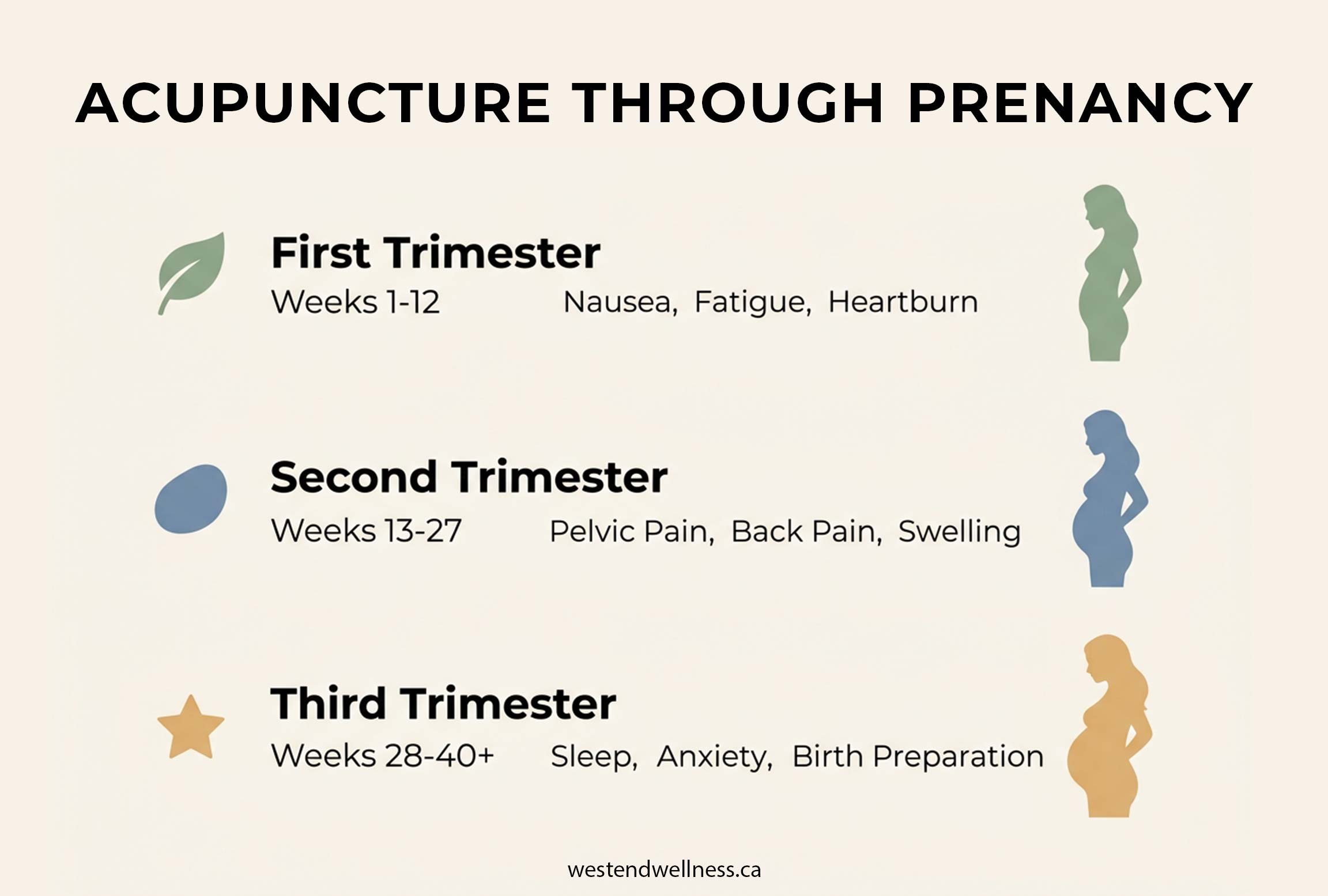
Here are the conditions most commonly sought with acupuncture during pregnancy, trimester by trimester.
-
Morning sickness is one of the most studied indications for acupuncture during early pregnancy. The PC6 point located on the inner wrist has been specifically researched for its effect on nausea, and is the same point targeted by sea-sickness wristbands.
Regular treatment in the first trimester can reduce nausea frequency and severity, and also helps with fatigue and early heartburn, without medication. For many people, this alone makes acupuncture worth adding to the routine. goes here -
As the bump grows, so does the physical load. Pelvic girdle pain, symphysis pubis dysfunction (SPD), low back pain, and constipation all become more common through the second trimester. Acupuncture helps by improving circulation to the pelvis, releasing muscular tension in the lower back and hips, and supporting digestive motility. For those dealing with swelling or fluid retention, it can also help the lymphatic system stay moving. Our article on prenatal massage during pregnancycovers how hands-on care complements this kind of treatment.
-
Sleep becomes increasingly difficult as the due date approaches — positions are limited, the mind is active, and the body is working hard. Acupuncture helps regulate the nervous system, which has a direct impact on sleep quality. For anxiety that builds in the weeks before birth, treatments can be deeply calming. Read more about how acupuncture supports the nervous system in our article on acupuncture for insomnia.
Pre-Birth Acupuncture: What It Is and When to Start
This is where acupuncture becomes particularly relevant to your conversation with your birth team. Pre-birth acupuncture refers to a specific protocol usually beginning at 36 weeks designed to prepare the body for labour.
It's one of the most researched applications of acupuncture in perinatal care, and the outcomes are worth knowing about.
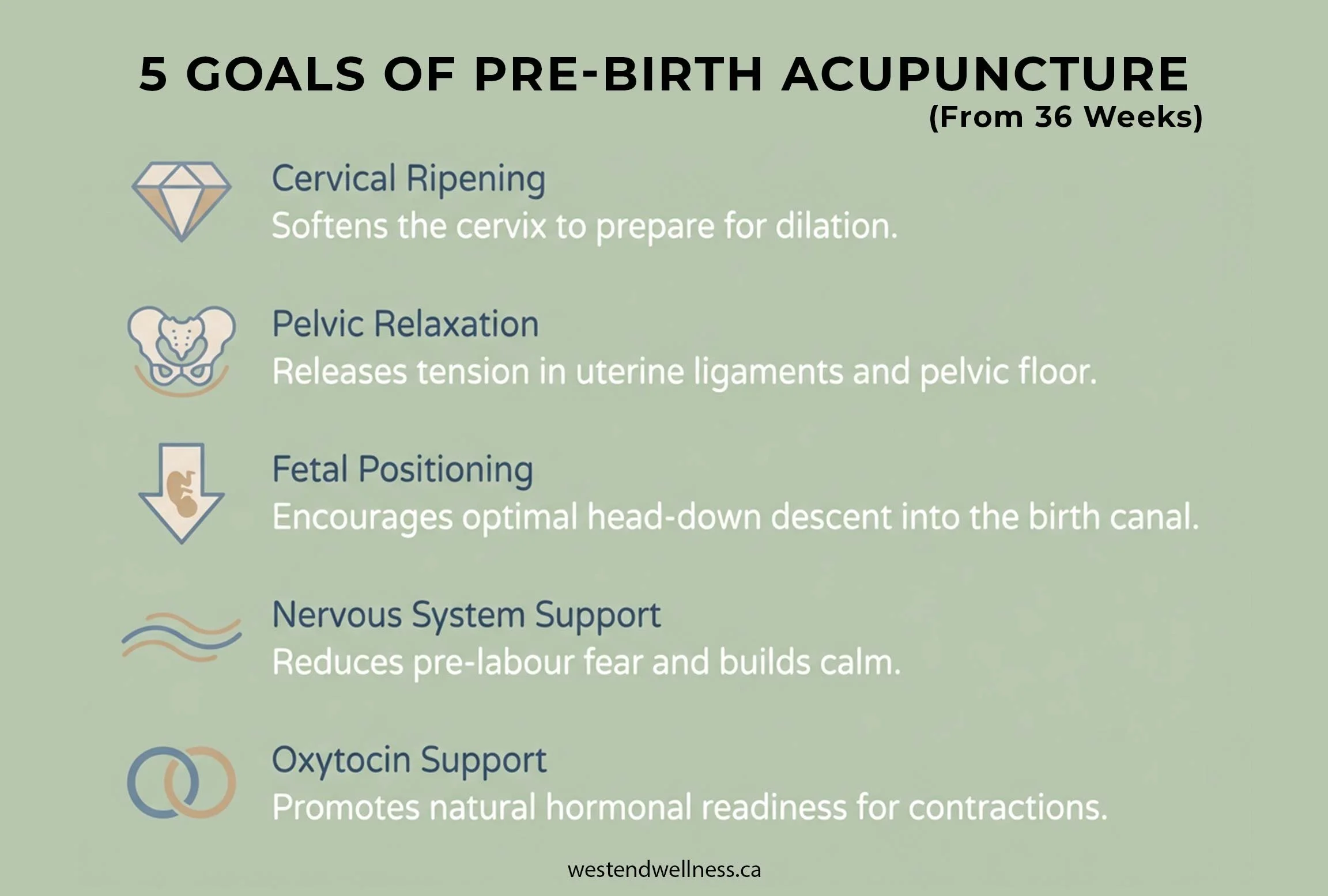
The goals of pre-birth acupuncture are:
Cervical ripening softens the cervix in preparation for dilation
Pelvic relaxation releases tension in the uterine ligaments and pelvic floor
Encouraging fetal descent into the birth canal in the optimal position
Calming the nervous system to reduce fear and tension going into labour
Supporting endogenous oxytocin release, the hormone that drives contractions
Clients who receive weekly pre-birth acupuncture from 36 weeks onward consistently report shorter labours and lower rates of medical intervention, including fewer epidurals and cesarean sections. A randomized single-blind controlled trial of 386 pregnant women with pelvic girdle pain found that acupuncture as an adjunct to standard treatment was superior to stabilizing exercises, with the acupuncture group showing significantly better pain outcomes.
One widely cited midwifery study found that regular pre-birth acupuncture was associated with labours that were, on average, about an hour and a half shorter. That's not a small number when you're the one in labour.
Treatments are typically weekly, 30 to 45 minutes, from 36 to 40 weeks. More frequent sessions may be recommended as the due date approaches or if specific concerns arise.
What About Breech Position & Labour Induction?
Two questions come up a lot in the third trimester: what if the baby is breech, and what if you go past your due date? Acupuncture has something to offer in both situations.
Breech Position and Moxibustion
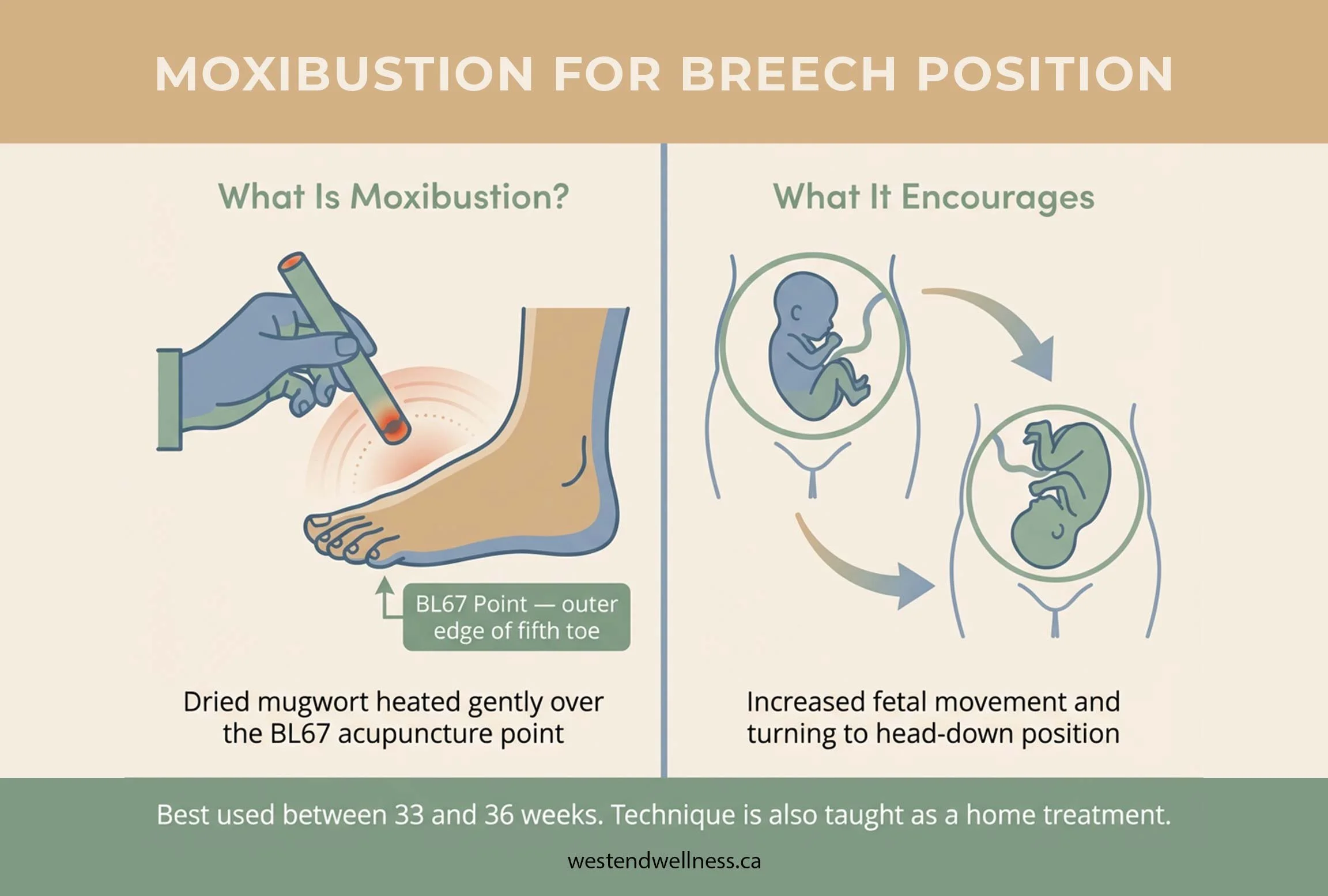
When a baby remains in the breech position past 33 weeks, the combination of acupuncture and moxibustion is the most studied non-medical intervention to encourage the baby to turn to the cephalic (head-down) position.
Moxibustion involves gently heating a specific acupuncture point on the outer edge of the fifth toe, called BL67, using a rolled stick of dried mugwort.
The heat and the stimulation at that point appear to increase fetal movement and create conditions that make turning more likely. You can learn more about this technique on our page on moxibustion. Practitioners typically also teach parents how to perform the home treatment between clinic sessions.
Post-Dates Induction Support
For pregnancies that go past 40 weeks, acupuncture can be used to support the natural onset of labour by stimulating points that promote oxytocin release and cervical softening.
This is not about forcing labour, it's about supporting the body's own readiness. Treatment frequency typically increases to every one to three days if labour hasn't started and the primary care team has cleared it.
The research in this area supports acupuncture's effectiveness over a placebo, though it works best when the body is already close to being ready.
Postpartum Recovery: Acupuncture Doesn't Stop at Birth
The birth team metaphor is useful here: a good team doesn't leave the field at halftime.
Postpartum is one of the most physically and emotionally demanding periods of life, and it's frequently underserved in terms of support. Acupuncture can play a real role in recovery after birth, whether the birth was vaginal or by cesarean.
Postpartum acupuncture is commonly used for:
Fatigue and energy rebuilding after blood and qi depletion during birth
Milk supply regulation, particularly in the first few weeks of breastfeeding
Mood support, including early signs of postpartum depression and anxiety
C-section scar tissue recovery and abdominal healing
Night sweats, hormonal fluctuations, and sleep disruption
Pair this with postpartum massage therapy, and you have a recovery plan that actually addresses the full picture — not just the medical side.
How to Include Acupuncture in Your Birth Plan
Adding an acupuncturist to your care team doesn't require anything complicated. Here's a practical approach:
Start early if you can. Acupuncture is most effective when it's building on previous sessions. Starting in the first or second trimester gives the treatment time to work, rather than arriving in week 38 and hoping for fast results.
Tell your midwife or OB. Integrated care is always better than parallel care. Most midwives in Vancouver are well familiar with acupuncture's role in birth preparation and will often refer directly.
Commit to the pre-birth protocol. Weekly sessions from 36 weeks are where the research is strongest. One or two sessions in the final stretch won't give you the same outcomes as a consistent lead-up.
Don't wait until something is wrong. Acupuncture as a preventive and preparatory tool performs better than acupuncture as a rescue intervention. Arriving before the symptoms are severe gives the treatments more room to work.
If you're based in Vancouver's West End and want to explore how acupuncture can fit into your prenatal care, our acupuncture team at West End Wellness works with expectant clients throughout all three trimesters and into the postpartum period.
Sessions are tailored to where you are in your pregnancy, with treatments adjusted at each visit based on how you're feeling and what's coming up.

Discover the benefits of prenatal massage for expecting mothers, including reduced muscle pain, boosted immune function, and a lower risk of prenatal depression.
FAQ About Acupuncture During Pregnancy
Is Acupuncture safe in the first trimester?
Yes, when performed by a qualified registered acupuncturist. There are specific points to avoid in early pregnancy, and any trained practitioner will know them. Acupuncture in the first trimester is most commonly used to relieve nausea, fatigue, and heartburn, and it is generally considered safe throughout all three trimesters.
How many sessions do I need before labour?
Most pre-birth protocols recommend weekly sessions starting at 36 weeks, continuing until labour begins. That's typically four to five sessions for a full-term pregnancy. Sessions may increase in frequency if you're past your due date and your primary care team has cleared induction support.
Can Acupuncture actually turn a breech baby?
The combination of acupuncture and moxibustion at the BL67 point has been studied and shown to be more effective than expectant management for encouraging breech babies to turn. It works best between 33 and 36 weeks, before the baby runs out of room to move. Results vary, but it's a low-risk option worth exploring early rather than waiting.
Will Acupuncture hurt?
Most people describe acupuncture as much gentler than they expected. You may feel a brief sensation when a needle is inserted, but sessions during pregnancy tend to use a lighter touch overall. Many clients fall asleep at the table. Discomfort during treatment is not typical, and you should always tell your practitioner how you're feeling.
Does it work alongside my midwife or OB?
Yes. Acupuncture is a complementary therapy, not a replacement for medical care. Most midwives in Vancouver are familiar with it and will often suggest it. Let both your acupuncturist and your primary care provider know what you're doing, as that communication makes for better outcomes.
Building a Birth Team That Actually Supports You
Pregnancy puts a lot of strain on your body. There's no single practitioner who can cover everything, which is exactly why a team approach matters.
Your midwife handles the medical side. Your doula supports you on the emotional and practical sides. And your acupuncturist works on the physiological preparation that helps your body do what it's built to do.
The earlier you start, the more consistent your sessions, and the more integrated your care team, the better the outcomes. Not every pregnancy will look the same. But most people who add acupuncture to their prenatal care say they wish they'd done it sooner.
If you're pregnant and curious about what acupuncture could do for you at this stage, our team is here to help. You can book an appointment online or reach out to us at info@westendwellness.ca with any questions.
If you have any further doubts or questions regarding this subject or another treatment, contact one of our experienced Acupuncturists or Registered Massage Therapists here at West End Wellness Clinic. You can either give us a call or make an appointment.
Disclaimer: Please remember this article is for informational purposes only and should not replace professional medical advice. Please consult a healthcare provider or someone with the correct qualifications before starting any new exercise or treatment program.