
Pickleball Is the Fun One, So Why Does Everything Hurt?
Table of Contents Show
Quick Summary
Pickleball may look gentle, but quick lunges, sudden stops, repeated gripping, and overhead reaches can place demand on your body. This guide explains why players often develop elbow, shoulder, knee, calf, ankle, or lower back pain, and how to distinguish normal post-game soreness from an injury that requires assessment.
You will also learn when Registered Massage Therapy may support mobility and recovery, when massage should wait, and how a short warm-up can prepare you for the court. Whether you are new to pickleball or playing several times weekly, the goal is simple: keep moving without ignoring warning signs.
TL;DR – Pickleball Injuries & Recovery
Movement: Pickleball loads joints through lunging, gripping, and rotation.
Pain: Elbows, shoulders, knees, calves, and ankles commonly complain.
Assessment: Sharp pain, swelling, weakness, or instability needs attention.
RMT: Treatment may support soreness, mobility, and muscular tension.
Preparation: Warm up gradually before increasing court speed.
Pickleball has a friendly reputation. The court is smaller than a tennis court, the paddle is light, and a casual game can feel more social than athletic.
Then you wake up the next morning, and your forearm is aching, your calf feels tight, or one knee suddenly has strong opinions about stairs.
That reaction is not as surprising as it seems. Pickleball combines short accelerations, abrupt braking, side-to-side movement, reaching, trunk rotation, and repeated gripping.
You may also play for much longer than expected because the game feels manageable while you are on the court.
Vancouver makes it especially easy to keep going. Outdoor courts fill up when the weather improves, and one game can turn into three while you wait for the rain to return.
For someone who has moved less during winter, a sudden increase in court time can quickly expose gaps in strength, mobility, and recovery.
Research on pickleball players has found injury patterns across both the upper and lower body, with sprains, strains, joint problems, and overuse complaints appearing regularly. Playing more frequently, playing on consecutive days, and having less experience may also raise injury risk.
The point is not that pickleball is dangerous.
The point is that it deserves the same preparation and recovery as any other sport.
Why Pickleball Can Catch Your Body Off Guard
The Court Is Small, but the Movements Are Fast
Most pickleball movement occurs over short distances.
That means you rarely build into a comfortable running rhythm. Instead, you react. You shuffle, plant one foot, reach outside your base of support, and stop your body before the next shot arrives.
These movements place demand on the calves, Achilles tendons, ankles, knees, hips, and lower back. A late reach can load one side far more than the other, especially when fatigue changes your footwork.
The Paddle Creates Repetition
The paddle is not particularly heavy, but weight is only part of the equation. Your hand, wrist, and forearm repeatedly stabilize the paddle while your elbow and shoulder guide each shot. A tight grip or a sudden jump in playing time can irritate tissues that were not prepared for hundreds of repeated swings.
Your Enthusiasm May Improve Faster Than Your Capacity
This is one of the most common patterns in recreational sport. You discover an activity you enjoy, improve quickly, and begin playing more often. Your skills and confidence rise before your tendons, muscles, and joints have adapted to the workload.
Clinic perspective: Pain often appears after the third weekly game, not the first. The problem may be the increase in total load rather than one technically bad movement.
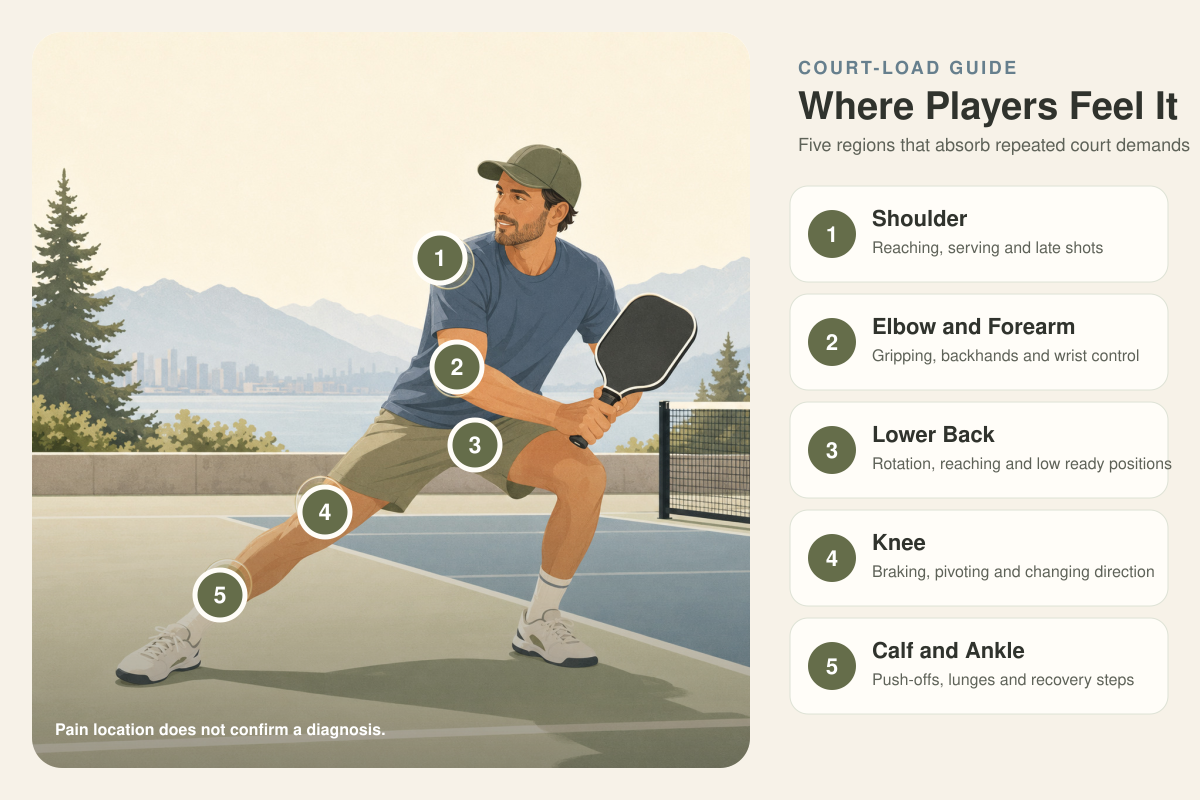
Common Pickleball Pain Areas
The repeated gripping, reaching, lunging, and quick changes of direction involved in pickleball can place stress on several parts of the body. Below are some of the most common pickleball pain areas.
-
Pain around the outside of the elbow is often described as pickleball elbow. It may feel tender when you grip the paddle, hit a backhand, turn a doorknob, or lift a mug.
The discomfort can involve the wrist extensor muscles and their tendon attachment near the elbow, but not every elbow problem has the same cause.
A grip that is too tight, late contact with the ball, repeated backhands, and a rapid increase in play can all contribute. Resting for one evening and then repeating the same load the next day may keep the area irritated. -
The shoulder must create movement while keeping the upper arm controlled in the joint. Reaching for a high ball, serving, and striking from an awkward position can challenge that control.
Players may notice tightness across the front or back of the shoulder, pain with overhead movement, or fatigue that changes their swing.
Pain accompanied by sudden weakness, a traumatic fall, significant loss of motion, or visible deformity requires assessment before hands-on treatment. -
Lower-body problems often happen during braking, pivoting, lunging, or pushing off. The ankle may roll when a player reaches too far. The knee may become irritated by repeated changes in direction.
The calf or Achilles region may tighten when the body accelerates before it is properly warm.
A sudden pop, rapid swelling, instability, severe bruising, or difficulty bearing weight is not ordinary post-game soreness. Stop playing and seek an appropriate assessment. -
Pickleball keeps you in a slightly crouched ready position. Add repeated rotation and reaching, and the lower back may begin doing work that should be shared by the hips and upper back.
Players often describe stiffness after the game rather than one dramatic moment of injury.
Pain travelling down the leg, new numbness, weakness, changes in bladder or bowel control, or severe pain following a fall requires medical attention.
A Quick Comparison of Pickleball Pain Patterns
Aching with gripping, backhands, or lifting
Best next step: Reduce aggravating play and arrange an assessment if it persists
Tightness, weakness, or pain when reaching overhead
Best next step: Avoid painful overhead loading and assess reduced strength or motion
Swelling, instability, or pain during direction changes
Best next step: Stop playing if the joint gives way or cannot bear weight normally
Tightness, cramping, or a sudden pulling sensation
Best next step: Sudden sharp pain needs assessment before massage or return to play
Stiffness after play or discomfort with rotation
Best next step: Gentle movement may help. Radiating pain or weakness needs assessment

Feeling unsure about your first massage therapy appointment is completely normal, especially if you are not sure what to expect. This article walks you through how to prepare for your first massage, helping you feel more comfortable and confident before your visit.
Normal Soreness or Something More Serious?
Muscle soreness usually develops gradually after unfamiliar or demanding activity. It tends to feel broad, achy, or stiff rather than sharply localized. Both sides may feel tired, and gentle movement often becomes easier once you warm up.
An injury is more likely when pain begins suddenly, follows a fall or awkward movement, changes how you walk or swing, or comes with swelling, bruising, instability, weakness, or reduced joint motion.
Arrange prompt assessment: Seek care after a suspected fracture or head injury, an obvious deformity, an inability to bear weight, rapidly increasing swelling, new numbness or weakness, chest pain, or severe symptoms that continue to worsen.
If you are unsure, do not use a deep massage to test whether the problem will loosen.
Assessment comes first. HealthLink BC advises seeking care when pain or swelling worsens, strength or movement decreases, or numbness, tingling, or colour changes develop.
How Registered Massage Therapy May Help Pickleball Players
A Registered Massage Therapist does more than press on the sore spot. Your appointment begins with a discussion of how the pain started, where you feel it, which movements aggravate it, and whether anything suggests that massage is not the right first step.
When treatment is appropriate, Registered Massage Therapy in Vancouver may help address muscular tension, tenderness, restricted movement, and the compensations that develop when you protect a painful area.
Treatment Is Based on the Stage of the Problem
A player with general forearm fatigue after a tournament does not need the same treatment as someone with a newly swollen ankle.
Pressure, positioning, treatment area, and session goals must match what your body can tolerate that day. For training-related tightness or post-game soreness, sports massage therapy may focus on the forearms, shoulders, hips, calves, and other tissues repeatedly loaded on the court.
Your RMT may also assess whether limited ankle movement, hip stiffness, or upper-back restriction is pushing another region to work harder.
Massage Supports Recovery, but It Does Not Make You Injury-Proof
Massage may help some people with post-exercise soreness, flexibility, and comfort. It cannot guarantee injury prevention, repair a fracture, or replace rehabilitation for a significant tendon, ligament, or joint injury.
This distinction matters. Treatment should help you understand what your body is doing and support a sensible return to movement. It should not simply make the area feel temporarily quieter, allowing you to ignore the same warning sign.
If you are deciding between treatment styles, our comparison of deep tissue and sports massage explains why deeper pressure is not automatically the better choice.
When Should You Book a Massage After Pickleball?
For General Tightness or Soreness
If your muscles feel broadly tired or stiff after increased activity, an RMT appointment may be appropriate once you have ruled out a more serious injury.
Treatment does not have to be aggressive. Early recovery work may use comfortable pressure and focus on movement rather than chasing pain.
Our guide to RMT massage for sore muscles explains what ordinary exercise soreness can feel like and when waiting may make more sense.
After a Sudden Injury
Do not book deep work immediately after a fall, ankle roll, sudden calf pull, or shoulder injury without first considering whether assessment is needed. New swelling and protective muscle guarding are information, not obstacles to push through.
Before a Tournament or Busy Week of Play
Avoid trying an unusually intense treatment immediately before competition. If you already receive massage and know how your body responds, lighter work may help you feel comfortable without leaving the tissue tender.
Discuss the timing and goal with your therapist rather than assuming more pressure will produce better performance.
A Better Five-Minute Start
Walking onto the court and hitting three easy shots is hardly a warm-up. Your preparation should gradually move from general activity to the exact movements the game requires.
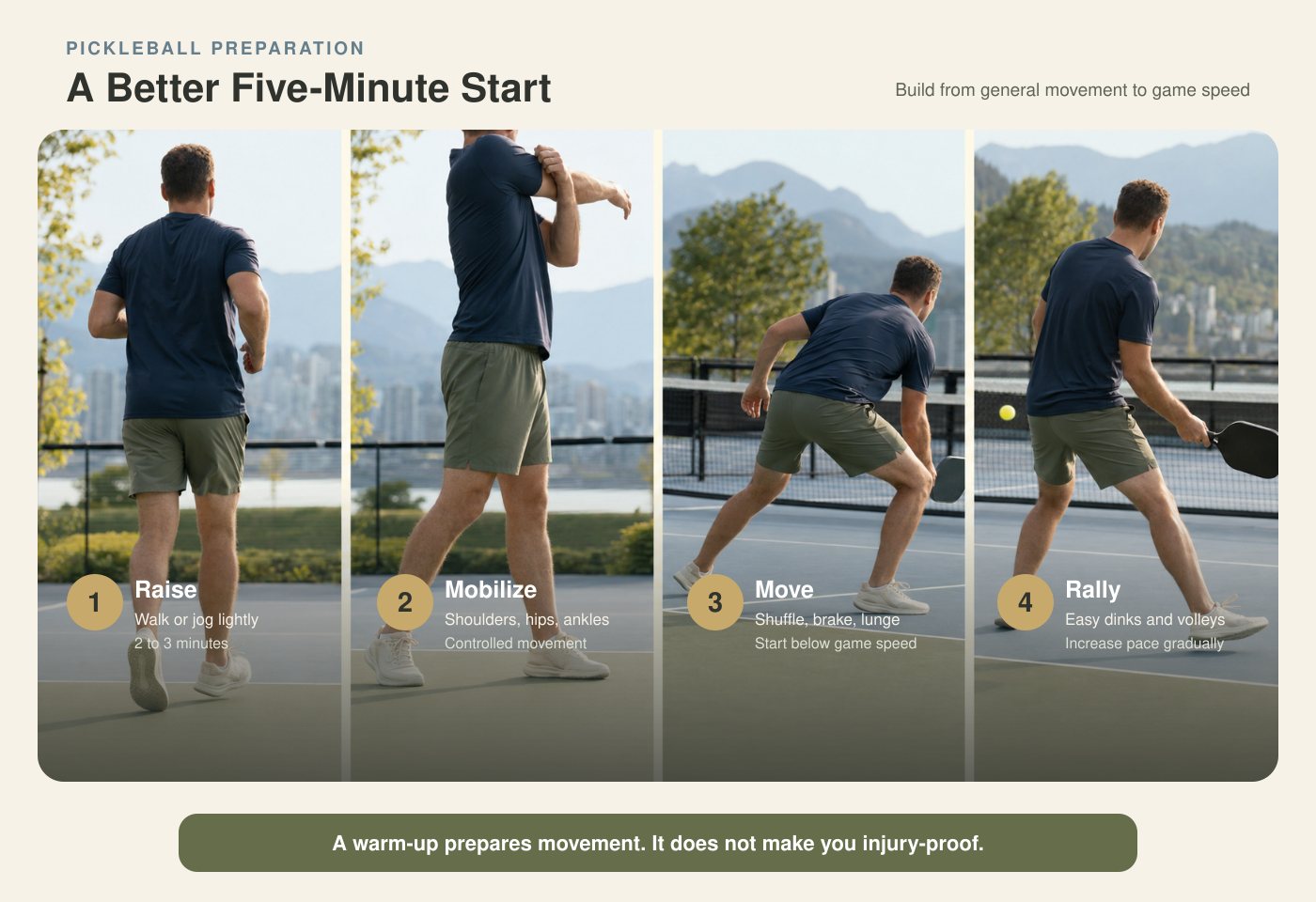
1. Raise your temperature: Walk briskly, jog lightly, or cycle to the court for two to three minutes.
2. Mobilize the main regions: Use controlled shoulder circles, trunk rotations, hip movements, ankle rocks, and gentle leg swings.
3. Practise court movement: Add small side shuffles, controlled lunges, and easy forward and backward steps. Begin below game speed.
4. Build through easy rallies: Start with dinks and controlled volleys. Increase reach, pace, and reaction demands gradually.
Important: A warm-up can prepare your body for movement, but no routine removes all injury risk. Fatigue, falls, workload, court conditions, and previous injuries still matter.
Common Questions About Pickleball Injuries
What are the most common pickleball injuries?
Pickleball injuries commonly affect the knee, ankle, calf, Achilles tendon, elbow, shoulder, wrist, and lower back. Falls can also cause fractures or head injuries that require medical assessment.
Can I get a massage immediately after a pickleball injury?
Not every new injury should be massaged immediately. Sudden sharp pain, rapid swelling, bruising, deformity, weakness, or difficulty bearing weight should be assessed before massage therapy.
Can massage therapy help pickleball elbow?
An RMT may help address forearm tension, tenderness, and movement restrictions associated with repetitive paddle use. Persistent elbow pain should be assessed so treatment matches the cause and stage of the problem.
When should I stop playing pickleball because of pain?
Stop playing if pain changes your movement, becomes sharp, causes weakness or instability, or continues to worsen. Seek prompt care after a fall, a suspected fracture, a head impact, or an inability to bear weight normally.
Should I choose RMT or acupuncture for a pickleball injury?
The better choice depends on the injury and your goals. RMT may be useful for muscular tension, mobility, and soreness. Acupuncture may be considered for pain management and recovery support. An assessment can help determine the appropriate option.
Small Changes That Make Court Time Easier to Recover From
Increase playing time gradually: Add duration or frequency in manageable steps instead of moving from one casual game to four sessions in a week.
Avoid stacking hard days: Consecutive high-volume sessions give irritated tissues less time to settle.
Use court-appropriate footwear: Shoes should support side-to-side movement and feel secure during braking and pivoting.
Relax your grip between shots: Constantly squeezing the paddle keeps the forearm working even when the ball is not in play.
Respect movement changes: If pain makes you limp, shorten your reach, or change your swing, continuing to play may load another area.
Recover like it counts: Sleep, regular meals, hydration, and appropriate rest remain more important than any single recovery tool.
Where Acupuncture May Fit
Some players use acupuncture as part of a broader plan for pain management and recovery.
At West End Wellness, the decision between RMT and acupuncture in Vancouver depends on the nature of the problem, the stage of recovery, your preferences, and what has already been assessed. You do not have to choose based on which treatment sounds stronger.
Start with the concern you are actually experiencing. If the presentation falls outside a practitioner's scope of practice or requires another form of care, you should be appropriately directed.
Final Thoughts
Pickleball is popular for a good reason. It is social, accessible, challenging, and easy to fit into a summer evening. A sore body does not automatically mean you should stop playing.
It does mean you should pay attention to how your body is responding. Broad muscle soreness after a new activity is different from a swollen joint, a sudden calf pull, or an elbow that becomes more painful every time you grip the paddle.
The earlier you recognize that difference, the easier it becomes to choose the right next step. If court time leaves you stiff, restricted, or uncomfortable, a Registered Massage Therapist can assess how you move and determine whether hands-on treatment is appropriate.
The goal is not to push you through pain. It is to help you return to the activities you enjoy with more clarity and confidence.
If you have any further doubts or questions regarding this subject or another treatment, contact one of our experienced Acupuncturists or Registered Massage Therapists here at West End Wellness Clinic. You can either give us a call or make an appointment.
Disclaimer: Please remember this article is for informational purposes only and should not replace professional medical advice. Please consult a healthcare provider or someone with the correct qualifications before starting any new exercise or treatment program.