
Commuter Stress: Why Your Shoulders Tighten on the Skytrain
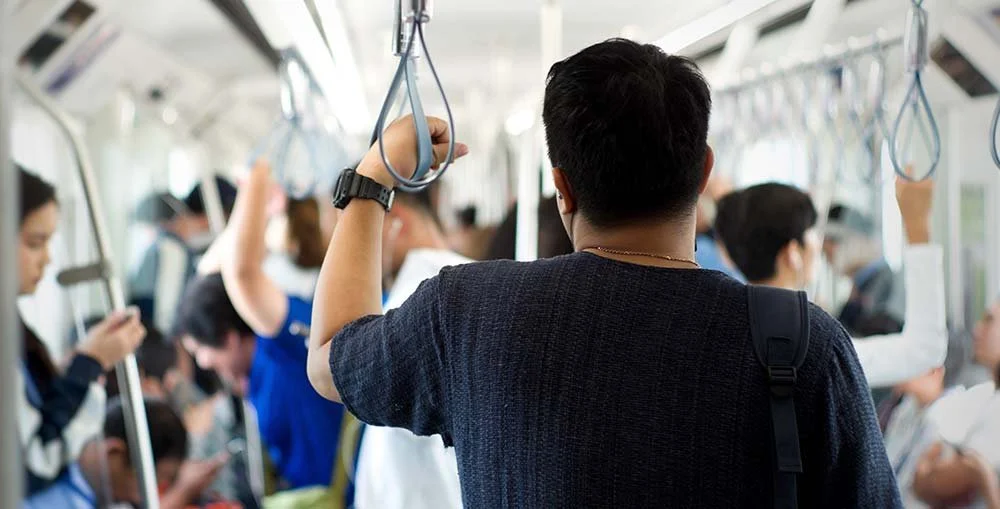
Table of Contents Show
Quick Summary
If you commute through Vancouver by SkyTrain, that familiar neck and shoulder tension may not be a coincidence. This article explores the hidden strain of daily transit, often called “Commuter Shoulder,” and explains why standing, bracing, and carrying heavy bags quietly overload your neck muscles.
You’ll learn simple on-the-go relief strategies, how therapeutic massage addresses deeper myofascial tension, and why treatment can improve sleep, headaches, and jaw tension. If your commute leaves you stiff, sore, or exhausted, this guide helps you understand the why and shows how to finally feel lighter again.
TL;DR – Why Your Shoulders Tighten on the Skytrain
Daily SkyTrain commuting causes neck and shoulder muscle overuse.
Micro-bracing tightens the levator scapulae, leading to stiffness and pain.
Heavy bags and poor posture worsen commuter-related shoulder tension.
Simple stance, posture resets, and bag switching reduce strain.
Therapeutic massage relieves tension, improves sleep, and prevents headaches.
Imagine it’s a typical Tuesday morning in Vancouver. The rain is doing that classic, sideways mist thing outside while you’re standing on a packed Expo Line train just as it pulls out of Burrard Station.
You have your morning coffee in one hand and your laptop bag slung over your right shoulder. Your left hand is gripped firmly onto the overhead strap. As the train jerks toward Waterfront, you feel it. There is that familiar, creeping tightness at the base of your neck. By the time you finally reach the office, your shoulders feel like they are practically wearing your ears as earrings.
If this sounds familiar, you aren't alone. In the wellness world, we often call this "Commuter Shoulder." If you take the Skytrain every day, this is likely your body’s way of filing a formal complaint.
Why the Skytrain is a "Shoulder Killer"
You might think you are just standing there, but your body is actually running a mini-marathon in stability while you ride. When the Skytrain accelerates or brakes, your muscles enter a state of micro-bracing to keep you upright.
The primary culprit here is your levator scapulae, a strap-like muscle in the back of your neck. Its main job is to lift your shoulder blade, but on a moving train it works overtime to keep your head and torso stable as momentum shifts. When this muscle is forced into sustained exertion, it begins to fatigue and tighten.
As these muscles fatigue, the mechanical structure of your neck can shift, often exaggerating the natural curvature of your spine. This change in posture is usually the root cause of that deep, gnawing ache that follows a long commute. If you are noticing these symptoms regularly, it may be helpful to explore the benefits of therapeutic massage to understand how we address these specific postural shifts.
Scientific research backs this up; a 2025 study found a significant link between longer commuting times and a higher rate of upper-body muscle pain. When you add a heavy laptop bag or backpack into the mix, the load on your muscles changes dramatically.
Research shows that carrying a heavy bag can nearly double the activation of your upper trapezius muscles. This pushes your body toward its fatigue threshold much faster than usual, leading to those stubborn knots that can eventually require a visit to our therapeutic massage clinic in downtown Vancouver for professional release.
The Commuter Style Comparison Table
While we all share the same Skytrain cars, we don't all carry our tension the same way. The way you stand, sit, or hold your belongings determines which muscle groups are taking the brunt of the physical stress. Recognizing your specific "style" is the first step in understanding why you feel stiff by the time you reach the office.
Take a look at the breakdown below to see which category fits your daily transit routine.
| Style | Physical Cost | Result |
|---|---|---|
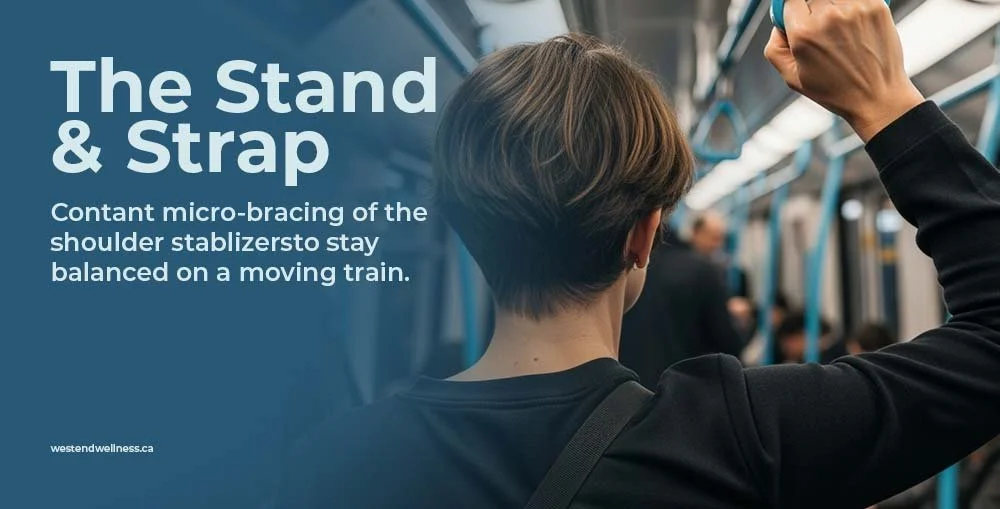
| The Stand-and-Strap | Constant micro-bracing of the shoulder stabilizers to stay balanced on a moving train. | The KnotTight upper traps and localized neck stiffness. |
| The Phone-Slumper | Forward head posture that adds significant mechanical pressure to the cervical spine. | The HeadacheTension headaches and reduced range of motion. |
| The Bag-Lunger | Uneven weight distribution that forces one side of the back to overcompensate. | The PullShoulder hiking and potential lower back strain. |
3 Simple "On-The-Go" Relief Tactics
Try these three subtle tweaks on your next trip through the Dunsmuir Tunnel to keep your muscles from locking up.
The Anchor Stance: Instead of standing with your feet close together, try keeping them hip-width apart and softening your knees slightly. This allows your larger leg muscles and your core to absorb the train's movement.
The Shoulder Blade Reset: Every couple of stations, imagine tucking your shoulder blades into your back pockets. Hold that position for about five seconds and then let go.
The Bag Switch: Carrying a heavy weight on one side causes your spine to curve and your muscles to tighten unevenly. Switching shoulders every time the train doors open keeps your posture balanced.
Clinical Insight: Research on postural stress shows that sustained postures like those adapted during a long commute are a primary cause of muscle imbalances in the neck extensors. According to a study in the Journal of Physical Therapy Science, these imbalances often lead to chronic tightness in the levator scapulae, which can significantly increase your risk of functional disability and pain.
The Cumulative Cost: When "Stiff" Becomes "Stuck"
It is a common misconception that one bad commute causes a knot. In reality, it is the cumulative effect of day-in, day-out micro-stress. When your muscles are under constant tension without adequate recovery, they enter a state of protective bracing. This is your body’s way of trying to prevent injury, but when left unchecked, it leads to three distinct stages of dysfunction:
The Ischemic Cycle (Reduced Blood Flow): Constant contraction squeezes the small blood vessels within the muscle. This limits the delivery of oxygen and nutrients while allowing metabolic waste products to build up, creating that "heavy" or "toxic" ache in your shoulders.
Myofascial Adhesions: Over time, the fascia the thin casing of connective tissue that surrounds your muscles begins to thicken and stick together. These "adhesions" act like internal glue, preventing your muscles from sliding smoothly and making every movement feel restricted.
Neural Sensitization: When a muscle is "on guard" for too long, your nervous system becomes hypersensitive. This means your brain continues to send "tension" signals to your shoulders even when you are sitting at home on your sofa or trying to sleep.
Without a professional "reset," these patterns become your body's new baseline. Breaking this cycle requires more than just a quick stretch; it requires a targeted approach to release the deeper layers of tissue and "down-regulate" the nervous system so it can finally let go of the commute.

Retraining Your "Body Map": Why Posture is a Skill
Often, the stiffness we feel isn't just about tight muscles it’s about proprioception, or your brain’s ability to sense where your body is in space. After months of bracing on the Skytrain, your brain’s "internal map" of your shoulders can become distorted. You might think your shoulders are relaxed, but they are actually hiked halfway to your ears.
A key part of our clinical work is helping you "re-map" these areas. By providing high-quality sensory input through manual therapy, we help your nervous system recognize what a neutral, relaxed posture actually feels like. This makes it significantly easier for you to maintain good posture during your commute without having to constantly think about it.
Tailored Tools for Every Commuter
Because every body responds differently to stress, we utilize a variety of clinical techniques to break the cycle of stiffness:
Myofascial Release (MFR): We use slow, sustained pressure to "unstick" the fascial adhesions that cause that feeling of being locked in place.
Trigger Point Therapy: We identify the specific "knots" in the levator scapulae and trapezius that refer pain to your head and neck, applying direct pressure to encourage the muscle fibers to reset.
Active Release Techniques: By having you move the muscle through its range of motion while we apply tension, we can more effectively break down scar tissue and improve mobility.
Joint Mobilization: Sometimes the stiffness in your shoulders is actually coming from a "stuck" joint in your cervical or thoracic spine. We use gentle oscillations to restore movement to the joints themselves.
Beyond the Commute: How Therapeutic Massage Provides Deep Relief
While stretches are great for maintenance, they often only address the "elastic" part of the muscle. When your levator scapulae has been bracing for your commute for months, the tissue can develop myofascial adhesions. These are areas where the muscle fibres and the surrounding fascia effectively "stick" together, limiting blood flow and trapping metabolic waste.
Therapeutic massage provides deep relief by focusing on three specific physiological goals:
Breaking the "Adhesion" Cycle: Through targeted pressure, a therapist can manually separate these stuck fibres, allowing the muscle to glide smoothly again rather than staying in a constant state of friction.
Down-Regulating the Nervous System: Your "commuter shoulders" are often the result of a nervous system that has forgotten how to turn the "on" switch off. Specialized techniques help shift your body from a stressed state into a restorative state, signalling those deep neck stabilizers that it is finally safe to let go.
Restoring Blood Flow: By applying and releasing pressure, we create a "pump" effect that flushes out the stagnant fluids that contribute to that dull, heavy ache in your upper back.
At West End Wellness, our approach is built on this clinical understanding. We do not just rub where it hurts; we look at the entire chain of movement to see why your body is overcompensating in the first place. By restoring the natural length of these muscles, we help your body find its balance again so you are not fighting your own posture every morning.
Our clinic is just a few blocks from the Burrard and Granville transit hubs, making it a convenient stop to decompress and actually fix the root cause of your tension before or after your workday.

This article examines how therapeutic massage provides a natural, hands-on approach to alleviating long-term discomfort. You’ll learn about the real benefits, what to expect during a session, and why massage is a safe and supportive treatment for many types of chronic pain.
Vancouver Commuter FAQ
Why does my neck feel stiffer after a long Skytrain ride than it does after a workout?
During a workout, your muscles are moving through their full range of motion, which promotes blood flow. On the Skytrain, your muscles are often stuck in "static loading," where they stay contracted in one position to maintain your balance. This lacks the "muscle pump" effect of exercise, leading to a buildup of metabolic waste and that signature heavy, stiff feeling in your shoulders.
Can "Commuter Shoulders" lead to tension headaches?
Absolutely. When the levator scapulae and upper trapezius become chronically tight from bracing on transit, they can refer pain up into the base of the skull. This often triggers tension-type headaches that feel like a tight band around your head, especially after a stressful rush-hour commute.
Is it better to sit or stand on the train to avoid back and shoulder pain?
Both have challenges. "Active standing" using the Anchor Stance allows your larger leg muscles to absorb the train's movement. However, sitting often leads to "Tech Neck," which can add up to 60 pounds of pressure on your cervical spine as you look down at your phone. If you do sit, try to keep your phone at eye level to keep your spine neutral.
How soon will I feel relief after a therapeutic massage for transit-related tension?
Most clients feel a significant "lightness" in their shoulders and an immediate increase in neck mobility after just one session. Because we work to down-regulate your nervous system and manually release deep trigger points, the "on-edge" feeling in your muscles typically resets right away.
If you have any further doubts or questions regarding this subject or another treatment, contact one of our experienced Acupuncturists or Registered Massage Therapists here at West End Wellness Clinic. You can either give us a call or make an appointment.
Disclaimer: Please remember this article is for informational purposes only and should not replace professional medical advice. Please consult a healthcare provider or someone with the correct qualifications before starting any new exercise or treatment program.