
Navigating Tech-Neck and Desk-Job Fatigue in Downtown Vancouver

Table of Contents Show
Quick Summary
Living and working in the heart of the city means your body is constantly adapting to the tools of your trade. From the morning commute to the final emails of the day, the forward-head shift known as Tech-Neck is often the silent reason behind that familiar afternoon fatigue and persistent neck tension.
Recognizing these patterns is the first step toward moving out of a state of constant physical bracing. Understanding the internal mechanics of this strain reveals why your energy dips and how targeted clinical care can help you reclaim a sense of supported, easy movement throughout your workday.
TL;DR – Navigating Tech-Neck and Desk-Job Fatigue
The Pattern: Sustained screen use and commuting habits lead to a forward head posture that adds significant mechanical load to your cervical spine.
The Performance Cost: This physical strain is a primary driver of 3 PM brain fog, tension headaches, and chronic shoulder fatigue.
Daily Awareness: Small resets like the Eye-Level Lift and The Doorway Open can help interrupt the cycle of bracing throughout your day.
Clinical Intervention: Professional RMT care is the catalyst needed to reset deep tissue memory and address the structural imbalances that self-care alone cannot reach.
It usually starts somewhere between Burrard and Granville.
Your phone comes out. Your shoulders round forward.
By the time you reach the office or step off the SkyTrain, your neck already feels tight. This particular commute often leads to a specific type of Skytrain shoulder tension that settles in before your workday even begins.
By mid-afternoon, there’s that familiar pull at the base of your skull. If you work or live in Downtown Vancouver, this probably sounds uncomfortably familiar.
What we often call “tech-neck” is not just a posture issue. It is a performance issue.
How you hold your head and shoulders affects how you breathe, how long you can focus, how your body handles stress, and even how much energy you have left at the end of the day.
We see this every week at West End Wellness, especially in professionals who spend long hours on laptops, phones, and transit.
This article is not about blaming screens or telling you to sit perfectly straight. It is about understanding what your body is adapting to and how those adaptations quietly shape your comfort, movement, and workday stamina.
By the end, you will understand why tech-neck develops, how it impacts both posture and performance, and what practical changes can help you feel more supported in your body while keeping up with the pace of city life.
The Invisible Weight: Why Your Body Feels Heaviest by 3 PM
Tech-neck doesn’t just affect posture. It quietly changes how you breathe, how long you can focus, and how drained you feel by the end of the day.
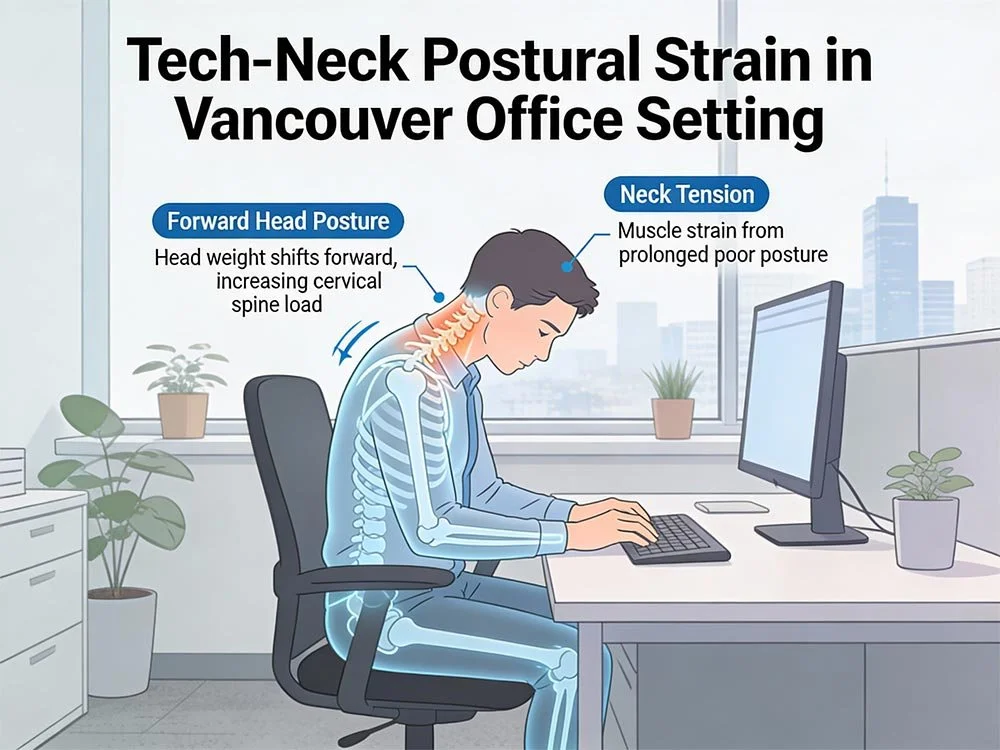
If you could see the physics of your spine while you’re deep in a project, you’d realize that your neck is performing a feat of endurance it was never meant to sustain. The human head weighs about ten pounds, roughly the weight of a bowling ball. When your ears are aligned over your shoulders, that weight is distributed effortlessly through your skeletal structure.
This alignment is the foundation of a neutral spine position, which is just as critical for your neck as it is for preventing low back pain.
But as your focus narrows and your chin drifts toward your screen, that bowling ball begins to tip. For every inch of forward lean, the mechanical pressure on your neck doubles. By the time you’re halfway through your afternoon emails, your upper back muscles aren't just "tight", they are exhausted from trying to keep that forty-pound load from falling.
This constant, quiet struggle is why the 3:00 PM wall feels so high. When your body is working this hard just to stay upright, your brain is forced to divert energy from your creativity to your survival. That "brain fog" isn't always about a lack of sleep; often, it’s simply the sound of your nervous system asking for a break from the strain.
More Than a Stiff Neck: The Ripple Effect on Your Day
At West End Wellness, we talk about posture changes because they rarely stay limited to the neck. They spread. When your shoulders round forward to meet your keyboard, the muscles across your chest slowly shorten and tighten. It is similar to wearing a vest that is just a bit too small. Everything feels slightly restricted.
That tightness does more than change how you look. It changes how you breathe. As the chest stiffens, the ribcage has less room to expand.
Breaths become shallower without you even noticing. Over time, your body stays in a low-level state of alert because it is missing the deeper breaths that signal safety and ease to your nervous system.
This is often why a desk job can feel draining, even on days that are not particularly stressful. Your body is working harder just to stay upright and alert. Understanding this connection is an important step forward.
Tech-neck is not just about correcting a curve in your spine. It is about creating space to breathe fully, focus longer, and move through Vancouver with less tension and more ease.
Once you understand how bad posture affects breathing and stress, the next question becomes obvious. Why does tech-neck develop so quickly, even in people who try to stay active? To answer that, we need to look at what modern work asks of the body.

Why Screens and Daily Habits Shape Your Posture More Than You Think
Most people do not develop tech-neck because of one bad habit. It builds quietly through repetition. Long hours at a screen, familiar seated positions, and small daily choices add up over time. Even people who stay active can feel the effects, because what your body does most often tends to shape it the most.
The Screen Magnet: When Focus Becomes Physical
We usually think of screen time as a mental task. For your body, it is a physical event. There is a subtle pull that happens when you are deeply focused. Your eyes lock onto the screen, your head follows, and your posture slowly shifts forward without you noticing. This sustained position is where adaptation begins.
When you spend hours in the same posture, your soft tissues start to change. Ligaments and fascia gradually stretch or shorten to match the position you spend the most time in, a process commonly described in research on connective tissue adaptation under sustained load.
Over time, your body begins to treat this shape as normal. If your workday is anchored by a screen, your posture is quietly being trained to stay in a slump, even after you close your laptop and walk home through Yaletown.
The Cost of the Sustained Position
Our bodies were built for movement. They are meant to shift between effort and rest throughout the day. Modern work environments often ask for the opposite. Long meetings, desk work, or standing still on a crowded SkyTrain require what is known as static loading.
When certain muscles remain activated for too long, blood flow slows, and oxygen delivery decreases.
This is a major reason people feel that heavy, burning sensation across the shoulders and upper back. It is not simply muscle fatigue. Research on the effects of static muscle loading shows that limited circulation plays a key role in discomfort and tension.
Restricted posture can also affect breathing. As the chest stiffens and the ribcage has less room to expand, breaths become shallower.
This can keep the body in a low-level state of alert, since deep, diaphragmatic breathing is one of the signals the nervous system uses to relax. Studies exploring breathing patterns and nervous system regulation help explain why desk work can feel stressful even on quiet days.
Reshaping Daily Habits: Small Wins in the City
The encouraging part is that posture changes are not fixed. The body adapts in both directions. Changing your relationship with tech-neck does not require a full lifestyle overhaul.
It starts by noticing the habits that happen on autopilot and introducing small moments of awareness throughout the day.
The commuter’s gaze: Instead of dropping your chin toward your chest while scrolling, try bringing your phone up to eye level. It may feel awkward at first, but it immediately reduces strain in the neck and shoulders.
The water break reset: Each time you stand up for water or coffee, use that moment as a cue to roll your shoulders back and take one slow, full breath. This simple reset helps counter the forward pull of desk work.
The desktop horizon: Every twenty minutes, look up and focus on something farther away, like the North Shore mountains. Relaxing the eye muscles often helps soften tension at the base of the skull as well.
These small shifts remind your body that it does not have to stay locked in one shape all day. Tech-neck develops gradually, but so does relief when movement, circulation, and breathing are gently reintroduced.
Small, Meaningful Adjustments for the Downtown Professional
To bridge the gap between understanding the strain and taking action, we need to look at how we navigate our workday. These aren't just "posture tips" to check off a list. They are small, intentional moments of recalibration designed to fit into the rhythm of a Vancouver professional’s life.
Whether you are waiting for your espresso in a crowded Yaletown cafe or sitting through a back-to-back marathon of Zoom calls, these adjustments are about sending a new signal to your nervous system.
By gently interrupting the patterns of tension we've discussed, you allow your muscles to soften and your breathing to expand.
Think of the following table as your personal toolkit for workday stamina. It connects the physical sensation you’re feeling to the underlying reason it’s happening, then offers a simple way to hit the "reset" button without leaving your desk.
Posture and Performance: Why Alignment Affects How You Work and Feel
Posture is often framed as a comfort issue, but it plays a much bigger role than most people realize.
How you hold your body throughout the day directly influences how well you focus, how quickly you fatigue, and how much energy you have left when work is done. In a fast-paced city like Vancouver, performance is not just about productivity. It is about how sustainable your day feels.
When posture collapses, the body has to work harder to stay upright. Muscles in the neck and upper back remain switched on longer than they should, which increases overall effort. This extra strain quietly drains energy that could otherwise support concentration and mental clarity.
Many people notice they feel foggy or restless by mid-afternoon, not because they are overwhelmed with tasks, but because their body is already tired.
Breathing also plays a role in performance. A rounded posture limits the ribcage's expansion, leading to shallower breaths. Shallow breathing reduces oxygen intake and keeps the nervous system more alert. Over time, this can make it harder to stay calm under pressure, think clearly in meetings, or transition out of work mode at the end of the day.
Good posture does not mean sitting rigidly or holding tension. It means giving your body enough support so movement and breathing feel easier.
When posture improves, many people notice they can focus longer, feel less reactive, and recover more quickly from stress. Workdays feel less draining, and evenings feel more like actual downtime.
Performance is not just about pushing harder. It is about reducing unnecessary effort. Supporting your posture helps your body work more efficiently, which leaves more capacity for thinking, creating, and moving through the city without feeling worn down.
From Pattern to Professional Treatment: The Role of Clinical Care
While small daily adjustments are vital for maintenance, many Vancouver professionals reach a point where the physical patterns are too deeply set to be reversed by stretches alone.
When your body has spent years adapting to a desk-based environment, the soft tissue develops a "memory" of that tension. This is where professional intervention becomes the essential next step.
At West End Wellness, our approach to treating "Tech-Neck" goes beyond the surface. We focus on breaking the cycle of postural adaptation through clinical techniques like myofascial release and trigger point therapy.
By addressing the specific muscle groups that have become shortened or inhibited, we help "reset" your baseline. This clinical work creates the physical space your body needs to actually benefit from the postural habits you are trying to build.
Coordinating Your Recovery
Real progress often comes from a combination of different therapeutic styles. For some, the path involves a focus on Sports Massage to address the structural imbalances caused by high-intensity work weeks. For others, the priority is Therapeutic Massage to calm a nervous system that has been stuck in a state of bracing for too long.
We often see that once the physical blockages in the chest and neck are cleared professionally, the "brain fog" clears along with them. You are no longer fighting your own body to get through your afternoon. Instead, you are supported by a foundation of easy, functional movement.
Whether your goal is to stay focused through a long boardroom session or to enjoy your weekend on the Seawall without a lingering ache, professional treatment is the bridge that gets you there.
From Sustained Tension to Clinical Recovery
We often meet professionals who have simply accepted daily neck tension as an unavoidable part of a successful career. They have grown used to the heavy fog that sets in by Tuesday afternoon and the stiffness that makes a weekend bike ride around the Seawall feel more like a chore than a release.
This isn't a sign that your body is failing; it is a sign that it has over-adapted to the static demands of your environment.
Real recovery begins with the realization that you don't have to carry that weight alone. While mindful resets are essential for daily maintenance, breaking the cycle of deep-seated muscle memory requires a targeted approach.
At West End Wellness, we focus on clearing the physical blockages in the chest and neck to restore your baseline comfort. Once that structural space is reclaimed, your body can finally move from a state of constant bracing to one of supported, easy movement.
Whether you are navigating a high-stakes meeting or the evening commute, professional care is the catalyst that allows you to show up as your best, most energized self.

Understand why good posture is crucial for your health and find practical solutions to achieve a healthier, more balanced lifestyle.
Frequently Asked Questions
Why does my neck pain always feel worse in the late afternoon?
By 3 PM, your muscles have likely spent hours in a state of "static loading." Without regular movement, the blood flow to your upper back and neck stabilizers decreases, causing metabolic waste to build up. This leads to that familiar burning sensation as your body struggles to support the weight of your head against the pull of gravity.
Can I fix Tech-Neck just by buying a better office chair?
While an ergonomic chair is a helpful tool, it is not a cure. Posture is a dynamic process, not a fixed position. Even in the best chair, your body will eventually slump or brace if you stay still for too long. Recovery requires a combination of changing your daily habits and seeking clinical treatment to release the tissue memory already locked into your muscles.
How often should I perform these "Mindful Resets" during the day?
Consistency is more important than duration. Aim to perform a reset like the "Back Pocket Tuck" or the "Eye-Level Lift" every 30 to 45 minutes. These micro-breaks take less than ten seconds but are vital for interrupting the cycle of tension and signalling to your nervous system that it is safe to relax.
When should I see an RMT for my desk-job fatigue?
If your stiffness persists even after a full night of sleep, or if you are experiencing frequent tension headaches, it is time for professional intervention. Clinical massage therapy addresses the structural imbalances that self-care cannot reach, providing the "reset" your body needs to respond to your daily stretches effectively.
Final Thoughts: Moving Forward with Purpose
Navigating a career in the downtown core shouldn't be synonymous with enduring chronic physical strain. Throughout this exploration, we have examined how the forward-head posture of Tech-Neck is a logical adaptation to our environment, one that quiets our energy and limits our focus.
By identifying these patterns, from the shortened chest to the silent back muscles, you have already taken the first step toward reclaiming your workday stamina.
Key Reminders for Your Week Ahead
Interrupt the Pattern: Remember that posture is dynamic; use the Eye-Level Lift on the SkyTrain and the doorway open at the office to keep tension from locking in.
Listen to the 3 PM Signal: That afternoon ache is a signal from your nervous system; take ten seconds for a neck pocket tuck to wake up your postural stabilizers.
Seek Clinical Support: Daily resets are for maintenance, but Registered Massage Therapy is the catalyst that resets deep-tissue memory and clears the path to lasting recovery.
The transition from a state of constant bracing to one of ease is not about achieving "perfection," but about building a more supportive relationship with your body.
Whether you are heading into a high-stakes meeting or enjoying a weekend walk near the Seawall, you deserve to move with confidence and clarity. At West End Wellness, we are here to support that transition, providing the clinical expertise to help you feel like yourself again.
If you have any further doubts or questions regarding this subject or another treatment, contact one of our experienced Acupuncturists or Registered Massage Therapists here at West End Wellness Clinic. You can either give us a call or make an appointment.
Disclaimer: Please remember this article is for informational purposes only and should not replace professional medical advice. Please consult a healthcare provider or someone with the correct qualifications before starting any new exercise or treatment program.